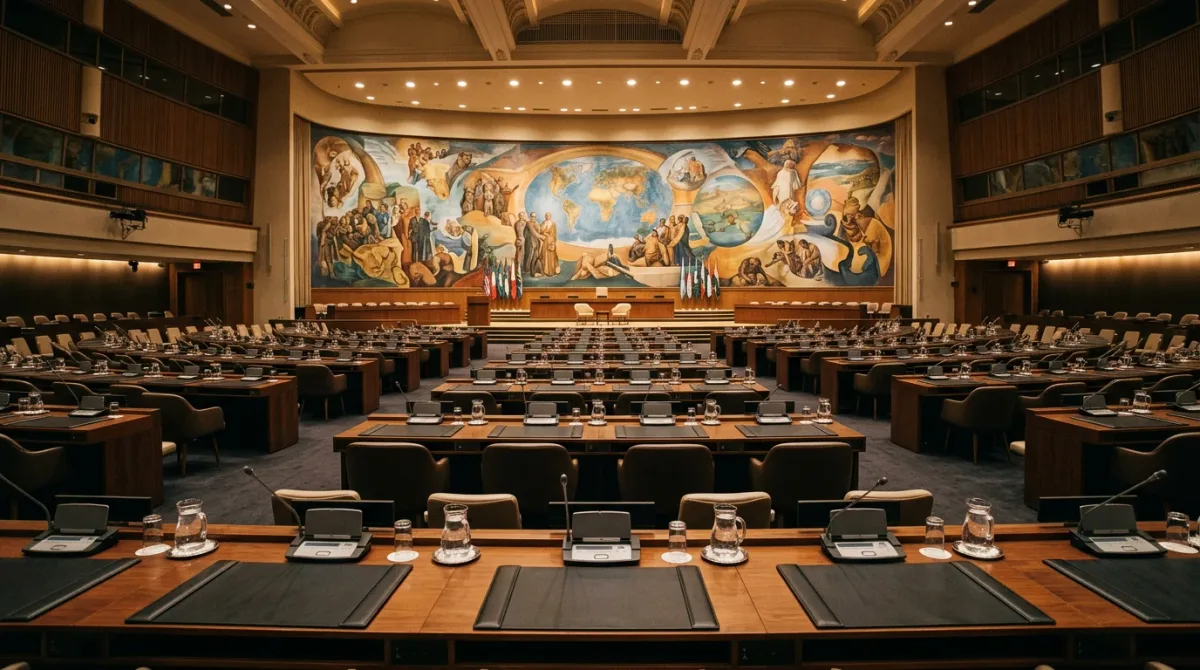
Since 2022, every veto cast by one of the UN Security Council's five permanent members has automatically triggered a General Assembly debate within ten working days, under General Assembly Resolution 76/262. The rule does not overturn the veto; it forces the vetoing power to explain itself publicly, as the United States did after blocking a Gaza ceasefire resolution in October 2025.
What Does Resolution 76/262 Actually Require?
Adopted on April 26, 2022, at the initiative of Liechtenstein, Resolution 76/262 requires the President of the General Assembly to convene a formal Assembly meeting within ten working days whenever a permanent Council member — China, France, Russia, the United Kingdom, or the United States — casts a veto. The rule applies uniformly regardless of which power exercises the veto or which issue is at stake.
The mechanism, known informally as the "veto initiative," does not give the Assembly power to reverse a Council decision. The General Assembly cannot bind the Council; its resolutions are recommendations. What the rule creates instead is a standing, procedural opening: a guaranteed session in which the vetoing state must justify its position before the full UN membership, and other governments can put their objections on the record.
Who Has Used the Veto Most, and On What?
The veto has been cast 293 times since the Soviet Union used it first, on February 16, 1946, according to Security Council Report, a nonprofit organization that tracks Council practice. Russia and its Soviet predecessor account for 120 of those vetoes, the largest share, followed by the United States with 82, the United Kingdom with 29, and France and China with 16 each.
Recent use clusters around a small number of conflicts. Security Council Report notes that the United States has cast 14 vetoes since 2020, all but two concerning Israeli-Palestinian resolutions, while Russia's vetoes since 2011 have concentrated heavily on Syria and, more recently, Ukraine.
How Has the Initiative Played Out Since 2022?
Veto activity has risen rather than fallen since the accountability rule took effect. Security Council Report's April 2026 assessment counted eight vetoes across seven draft resolutions in 2024 — four Russian, three American, one Chinese — the highest annual total since 1986. In 2025, four vetoes followed: two American vetoes on Gaza-related resolutions and two Russian vetoes on proposed amendments concerning Ukraine.
Each of those vetoes set the ten-day clock running. By mid-April 2026, the mechanism had convened its 21st General Assembly meeting since 2022, according to remarks delivered by the President of the General Assembly on the UN's official website — evidence that the debate has become a routine, if not decisive, feature of Council politics.
What Happened When the U.S. Vetoed a Gaza Ceasefire in 2025?
On October 1, 2025, the General Assembly met after the United States blocked a Security Council resolution calling for a Gaza ceasefire, a text that had drawn 14 votes in favor and only the single U.S. veto against it. Washington's representative told the Assembly the draft "failed to condemn Hamas and it failed to recognize Israel's right to defend itself," according to the UN's own meeting coverage.
Denmark, speaking for the ten elected Council members who had backed the resolution, voiced frustration that a text with overwhelming support had still failed. Israel welcomed the veto; the Palestinian delegation urged acceptance of a separate peace framework while pressing for an immediate ceasefire. Russia and China joined several other delegations in describing the veto as an excessive use of permanent-member privilege. No vote was taken in the Assembly itself — the session's function was scrutiny, not reversal.
What Triggered the Most Recent Debate, in April 2026?
The initiative's 21st meeting followed vetoes cast on April 7, 2026, over a resolution concerning freedom of navigation in the Strait of Hormuz. Addressing the Assembly on April 16, the President of the General Assembly linked the stakes directly to global markets, noting that disruptions tied to the underlying conflict had helped push oil prices up more than 40 percent, to roughly $100 to $110 a barrel, while removing as much as 1.5 million barrels a day from global supply.
The President described the initiative as established "to increase accountability around the glaring misuses of the veto" and urged member states to move beyond debate toward "concrete, forward-looking solutions, including draft resolutions" — language that captures both the mechanism's ambition and its structural limit: the Assembly can propose, but only the Council can act with binding force, and there the veto still governs.
Does the Debate Actually Constrain the Vetoing Power?
Security Council Report's own assessment is measured. It calls the veto initiative "a positive development that promotes accountability and transparency," while cautioning that "additional avenues need to be pursued" to address what it frames as veto misuse — an acknowledgment that a guaranteed debate is not, by itself, a check on how the veto gets used.
What the record since 2022 shows is narrower but real: a rule applied evenly to all five permanent members, invoked automatically rather than at anyone's discretion, that has produced a public accounting after every veto cast in the past four years, from Gaza to Ukraine to the Strait of Hormuz. Whether that accounting changes state behavior is a separate question from whether it happens — and on the evidence so far, it happens reliably, even as the underlying vetoes it responds to have grown more frequent, not less.
For a related culture perspective, read The Quiet Machinery That Chooses a Nobel Laureate in Literature.
For more context, read The Migrant Mother Negatives Are a Public Record.
For more context, read How the Pentagon Budget Cycle Actually Works, Year by Year.
For more context, read President Biden Names Fifty-Sixth Round of Judicial Nominees.