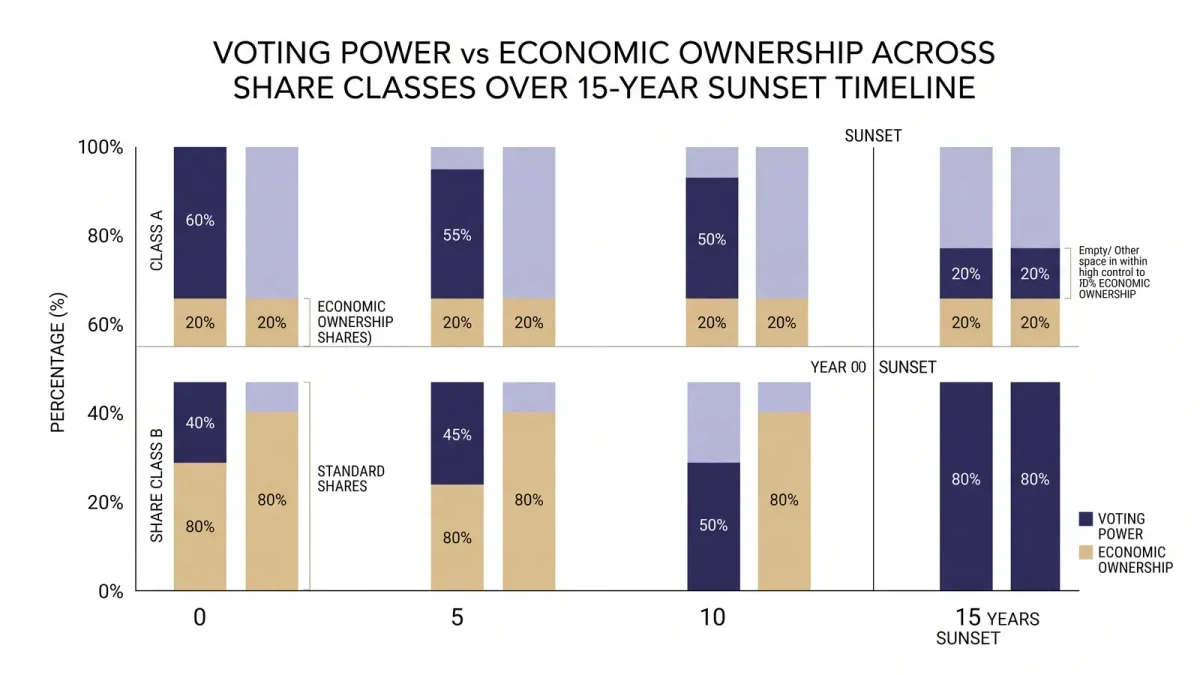
Dual-class share structures issue two or more classes of common stock with different voting rights — typically Class B shares carrying 10 or 20 votes each held by founders, and Class A shares with one vote sold to the public. The structure decouples economic ownership from voting control: founders of Meta, Alphabet and Snap retain majority voting power with a minority of the equity. The governance cost is measurable — proxy advisers and large institutional investors oppose new dual-class IPOs without sunset provisions — and the legal cost is doctrinal: controlling-shareholder status triggers entire-fairness review in Delaware, whatever the label.
USA Post publishes information about governance structures, not investment or legal advice.
Why do companies adopt dual-class structures?
The founder-control argument: protection of long-term investment horizons from short-term market pressure, insulation during strategy execution, and — in founder-sensitive industries — retention of the person deemed to be the company's engine. The empirical record is mixed: studies find modest innovation effects in some samples and entrenchment costs in others; what is settled is the concentration itself. Roughly a third of technology IPOs since 2017 used multi-class structures, though the share has declined as investor resistance hardened — S&P 500 inclusion policy excluded new dual-class listings from 2017 (and S&P proposed closing the crossover loophole in 2023), and FTSE Russell's 2022 requirement effectively banned new dual-class constituents without one-share-one-vote within five years.
What are sunset clauses and why do investors demand them?
Sunsets terminate the superior voting rights on defined triggers: time-based (most common — seven to fifteen years after IPO), transfer-based (sale of founder shares), ownership-based (founder equity falling below a threshold), or death/incapacity. The Council of Institutional Investors' campaign made time-based sunsets the market standard for new listings: Glass Lewis and ISS recommend against directors of companies adopting dual-class without them, and several prominent 2019-2021 IPOs adopted time sunsets in response. The evidence on sunsets is instructive — research finds time-based sunsets recover most of the valuation discount, while transfer-based sunsets alone (the Google/Meta pattern, ending only on transfer) lock control for decades. The Insulet-style voluntary collapses — companies unifying share classes by charter amendment with founder consent — remain rare and contested.
How do courts treat dual-class controllers?
As controlling shareholders. Delaware law asks whether a stockholder — through ownership or contract — exercises control over the corporation; a founder with majority voting power is one regardless of economic stake, and transactions where the controller stands on both sides face entire-fairness review: fair process and fair price, burden on defendants. The MFW framework gives controllers an exit to business-judgment review — an independent special committee formed before negotiations plus an informed majority-of-the-minority vote — but recent case law (the Delaware Supreme Court's 2024 In re Match Group-adjacent decisions and the 2025 Park line on safe-harbor mechanics) tightened what counts, and the 2024 amendments to DGCL 144 and the Chancery docket's scrutiny of controller maneuvers have made the cleansing path narrower in practice. Dual-class companies also face the Brookfield Asset Management problem: controlling-shareholder status can attach through agreements even below majority ownership, an issue for founder-CEO companies with dual-class plus voting agreements.
What does the empirical literature say about performance?
Mixed, and the disagreement is honest. Early studies of U.S. IPOs found dual-class firms slightly outperforming on revenue growth and R&D intensity, with valuation discounts at IPO; later work reconciles by horizon — discounts widen with control longevity, and most of the discount attaches to transfer-only sunsets and no-sunset structures. A meta-reading consistent across studies: markets price insulation from takeover and proxy contests as an agency cost, discount it, and discount it less when the insulation is temporary. Corporate-governance scholarship since 2018 (Gompers, Ishii, Metrick's foundational work and successors) frames the question as a trade between founder-specific human capital and entrenchment — a firm-specific judgment investors can price only with the sunset terms visible.
What should boards and investors watch?
- Sunset type and length: time-based sunsets under ten years recover most of the discount; transfer-only sunsets do not.
- Vote caps and governance guarantees: some charters cap insider voting or entrench independent-majority provisions, softening control concentration.
- Controller transactions: any deal where the founder benefits differently from the class — recapitalizations, re-IPOs, carve-outs — invites entire-fairness scrutiny and MFW structuring.
- Minority protections: majority-of-the-minority votes on major related-party matters are cheaper insurance than litigation.
- Unification proposals: when a controller offers collapse, the terms — exchange ratios — are themselves controller transactions reviewed for fairness.
Is the tide turning against dual-class?
Against permanent dual-class, yes; against time-boxed founder control, no. Index inclusion rules, proxy adviser policies and investor stewardship guidance converge on the same position: founders may rent control for a defined period, priced by the market, but perpetual decoupling of votes from capital has lost its respectable defenders. For companies yet to list, the design choice is no longer whether to include a sunset but which one — and for investors, the sunset terms are where the governance analysis begins.