Corporate sustainability disclosure in 2026 is governed by three overlapping regimes: the ISSB standards (IFRS S1 and S2) that a growing list of jurisdictions are adopting as a national baseline; the EU's Corporate Sustainability Reporting Directive, whose scope was cut sharply by the Omnibus simplification package moving through Brussels in 2025; and California's climate statutes SB 253 and SB 261, which survived preemption challenges and reach any large company doing business in California regardless of where it is listed. The SEC's own climate rule, adopted March 2024, was stayed nationwide amid litigation and effectively shelved — leaving companies to build programs around frameworks the commission does not administer.
USA Post publishes information about disclosure regulation, not legal advice.
What do the ISSB standards require?
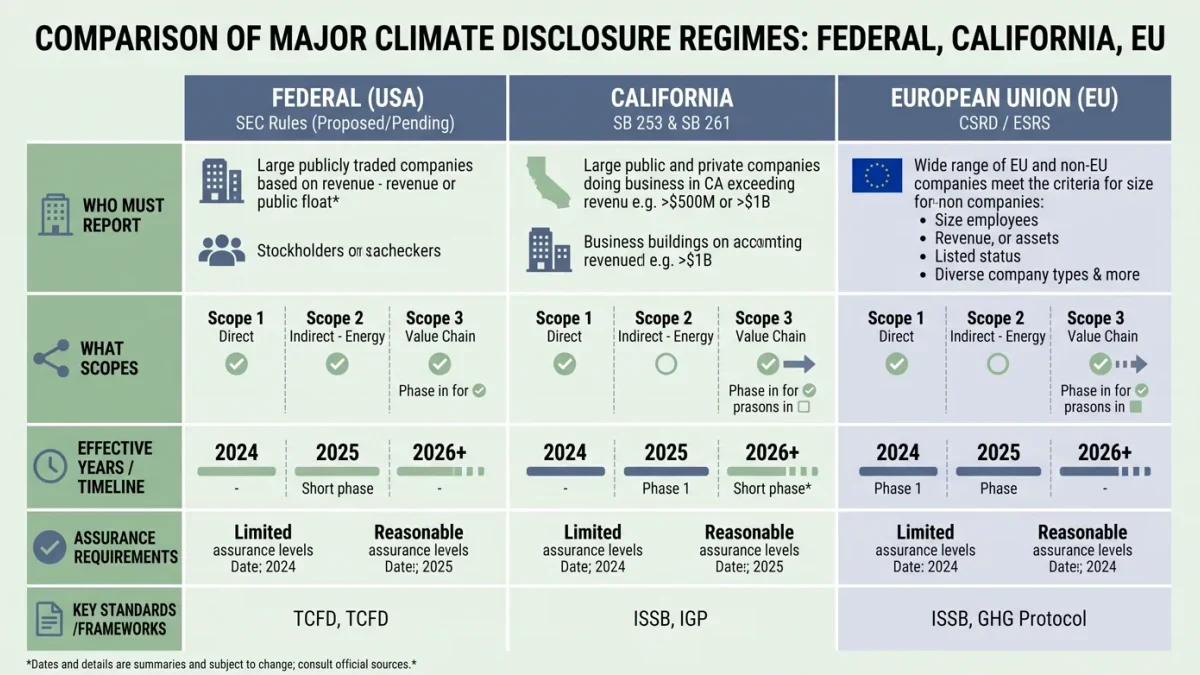
The International Sustainability Standards Board's IFRS S1 (general sustainability) and S2 (climate), issued June 2023, require disclosure of material sustainability-related risks and opportunities, governance processes, and metrics including Scope 1, 2 and — with transition relief — Scope 3 greenhouse gas emissions, with assurance expectations phasing in. The ISSB does not regulate anyone directly; it sets a baseline that jurisdictions adopt: by 2025 more than 30 economies, representing a large share of global GDP, had adopted or announced alignment, including through existing national frameworks in the UK, Japan (SSBJ standards aligned in 2025), Australia, Canada and others. For U.S. multinationals, ISSB matters contractually and competitively: subsidiaries and listed arms abroad are pulled into local adoptions.
What changed with the EU's Omnibus package?
The CSRD as originally in force covered roughly 50,000 companies with reporting phased from fiscal 2024. The Omnibus I proposal, presented February 2025, would cut the scope to about 7,000 — companies with more than 1,000 employees — delay the wave-two and wave-three reporting by two years ("stop-the-clock" directives adopted in 2025), and simplify the European Sustainability Reporting Standards. Non-EU parent companies with major EU turnover face their own timeline, deferred toward 2028 under the proposal. For U.S. companies the practical result is bifurcation: fewer EU-scope entities, but the ones still in scope face the most demanding regime in the world — double materiality, ESRS datapoints, limited assurance moving to reasonable over time.
What do California's SB 253 and SB 261 require?
Two statutes, one bundled enforcement story. SB 253 (Climate Corporate Data Accountability Act) requires companies with over $1 billion in revenue doing business in California to report Scope 1 and 2 emissions from 2026 on 2025 data, and Scope 3 from 2027, with assurance. SB 261 requires companies over $500 million to publish climate-risk reports aligned to TCFD by January 1, 2026. The U.S. Chamber of Commerce's preemption suit failed in the Central District of California in February 2025, and the court severed a discretionary provision that would have violated the First Amendment while upholding the mandatory disclosures; the litigation continued on appeal through 2025 with the statutes operative. "Doing business in California" reaches far: the state's sales-factor threshold means most large national companies are in scope, wherever headquartered.
How should boards govern this landscape?
- Inventory applicable regimes by entity: EU subsidiaries, California thresholds, ISSB-adopting jurisdictions where the company lists or operates.
- Assign ownership: audit committees have absorbed sustainability reporting in most large companies, with a sustainability committee coordinating; assurance providers must be engaged early, since Scope 3 data takes years to mature.
- Prepare for litigation risk on both sides: anti-greenwashing enforcement by the FTC, SEC and state attorneys general on one side, activist and securities claims over missing disclosure on the other — the California attorney general's 2025 letters warning about generic net-zero statements being the current example.
- Align with financial reporting controls: whatever regime applies, the internal-controls-over-financial-reporting analogy — documented data lineage, review sign-offs — is the operating standard.
- Watch the direction: EU simplification cuts scope, ISSB adoptions spread it, California proves state-level mandates survive federal retreat.
What happened to the SEC climate rule?
Adopted March 2024 with material Scope 1/2 disclosure and governance reporting — Scope 3 dropped from the proposal — it was stayed within weeks by the Eighth Circuit pending consolidated challenges, and in 2025 the commission voted to end its defense of the rule, signaling withdrawal or re-proposal rather than enforcement. The consequence is not the absence of climate disclosure: large issuers still report under California and EU law, and investor expectations fill gaps. The consequence is asymmetry — no single federal template, leaving companies to reconcile state and foreign regimes that ask similar questions in different formats.
Is ESG disclosure contracting or expanding?
Both, by jurisdiction. Brussels cut scope and delayed; the ISSB baseline spreads through national adoptions; California holds; and the anti-ESG counter-current produced its own disclosure laws in states like Texas (portfolio-level reporting for financial firms). The multinational board's answer is architectural: one data platform, mapped to every applicable regime, with governance that can absorb the next change — because on present trend there will be one.