Say-on-pay is the advisory shareholder vote on a public company's executive compensation, required at least every three years under the Dodd-Frank Act of 2010. The vote binds nothing: a company whose shareholders reject its pay practices by a majority may keep them. But the vote restructures incentives — compensation committees redesign programs ahead of feared failures, proxy advisers campaign against outliers, and Delaware courts have used failed votes as evidence in litigation over/board responsiveness, most visibly in the litigation over Tesla chief executive Elon Musk's 2018 pay package, which shareholders ratified twice and a Delaware court still voided in 2024, a ruling under appeal through 2025.
USA Post publishes information about governance regulation, not legal advice.
What exactly do shareholders vote on?
Rule 14a-21 under the Securities Exchange Act requires three ballots. The core say-on-pay resolution asks shareholders to approve, on an advisory basis, the compensation of named executive officers as disclosed in the proxy's Compensation Discussion and Analysis. A frequency vote — every one, two or three years — must be held at least once every six years; "annual" has won at the large majority of S&P 500 companies, and most boards follow the preferred frequency. Golden-parachute compensation tied to mergers gets a separate advisory vote in the deal proxy. Companies must disclose the prior year's result and, where shareholders rejected a plan, what the committee did about it.
What happens when shareholders vote no?
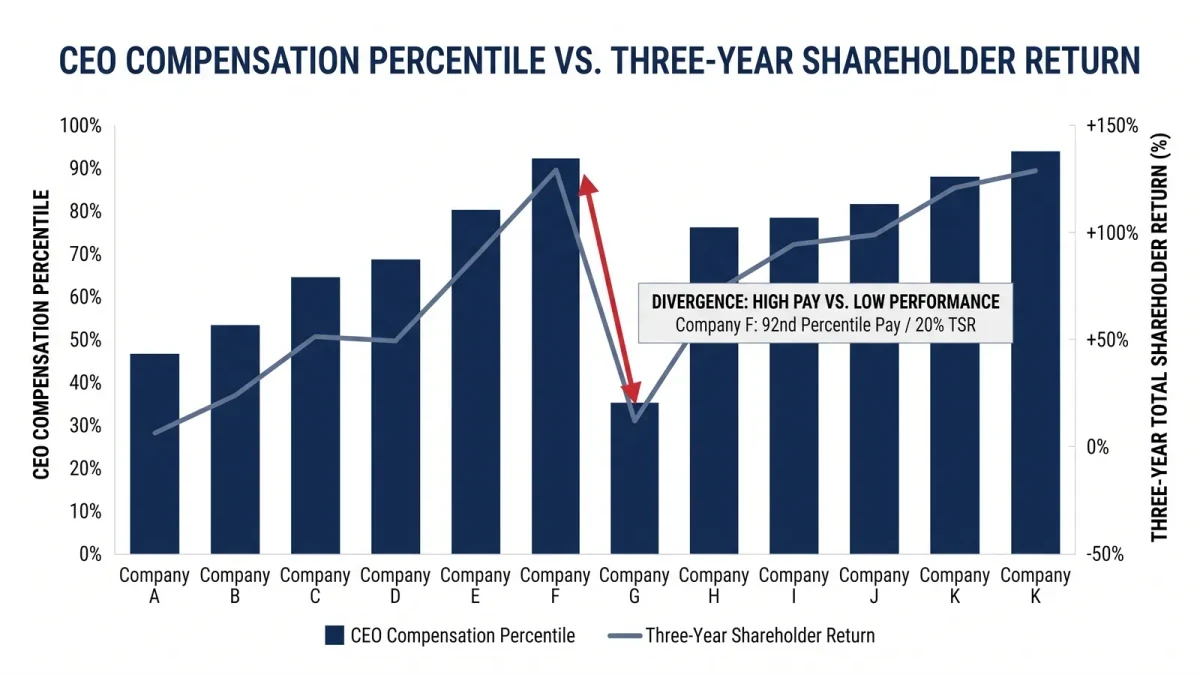
Procedure, not reversal. The compensation committee must consider the outcome, and the proxy the following year must describe responsive changes. Boards that ignore a majority-against vote face escalating pressure: proxy advisers recommend against compensation-committee members at repeat offenders, and institutional investors escalate to votes against directors. Data compiled by compensation consultancies through 2025 show average say-on-pay support at Russell 3000 companies in the 90-percent range, with failure rates under 2 percent — but failures cluster: highly leveraged pay packages and pay-for-performance disconnects account for most.
How did the Tesla litigation test the vote's limits?
The 2024 Delaware Court of Chancery decision in Tornetta v. Musk voided Musk's 2018 option package — worth tens of billions at various points — despite shareholder ratification, holding that a controlled-company conflicted grant must be entirely fair regardless of a later vote, and that ratification could not cure disclosure deficiencies and process gaps at grant. The Delaware Supreme Court heard the appeal in 2025; whatever the final word, the case established that say-on-pay ratification is not a cleansing device for conflicted grants. For ordinary companies, that principle rarely bites — but for controlled companies and founder-led firms with supermajority insider voting power, the advisory vote's protective sheen is thin.
How do proxy advisers and pay-for-performance tests shape outcomes?
Institutional Shareholder Services and Glass Lewis publish voting policies keyed to quantitative screens: multi-year total shareholder return relative to peers, pay magnitude percentile, and the alignment between the two. ISS's quantitative screen flags misalignment; qualitative overrides consider disclosure quality and committee responsiveness. Say-on-pay support correlates strongly with passing these screens, which is why compensation committees benchmark against them in advance — a practical consequence the drafters of Dodd-Frank did not write into the statute but that governs more pay design than any rule text.
What should a compensation committee do with a failed vote?
- Conduct outreach to major holders within weeks of the meeting to learn the objections — opaque metrics, one-off awards, discontinuity with performance.
- Adopt specific, disclosed changes for the following cycle: clarified performance metrics, caps or share-holding requirements, elimination of single-trigger severance.
- Document deliberations and responsiveness in the next CD&A, which courts and advisers read as the responsiveness record.
- Escalate engagement: committee chairs, not only investor-relations staff, meet the largest dissenting holders.
- Avoid cosmetic changes; advisers flag unexplained reversals of prior reforms as harshly as inaction.
Is say-on-pay here to stay?
Every structural review says yes. The vote is cheap to run, investors treat it as a floor of accountability, and repeated congressional proposals to make it binding have gone nowhere as of 2026. Its real function is informational: an annual, quantified, public measurement of how the owners judge the pay system — one that courts, plaintiffs and advisers all cite. Compensation committees that treat the vote as a live referendum, rather than a formality, rarely meet the 2 percent of cases where it becomes a litigation exhibit.