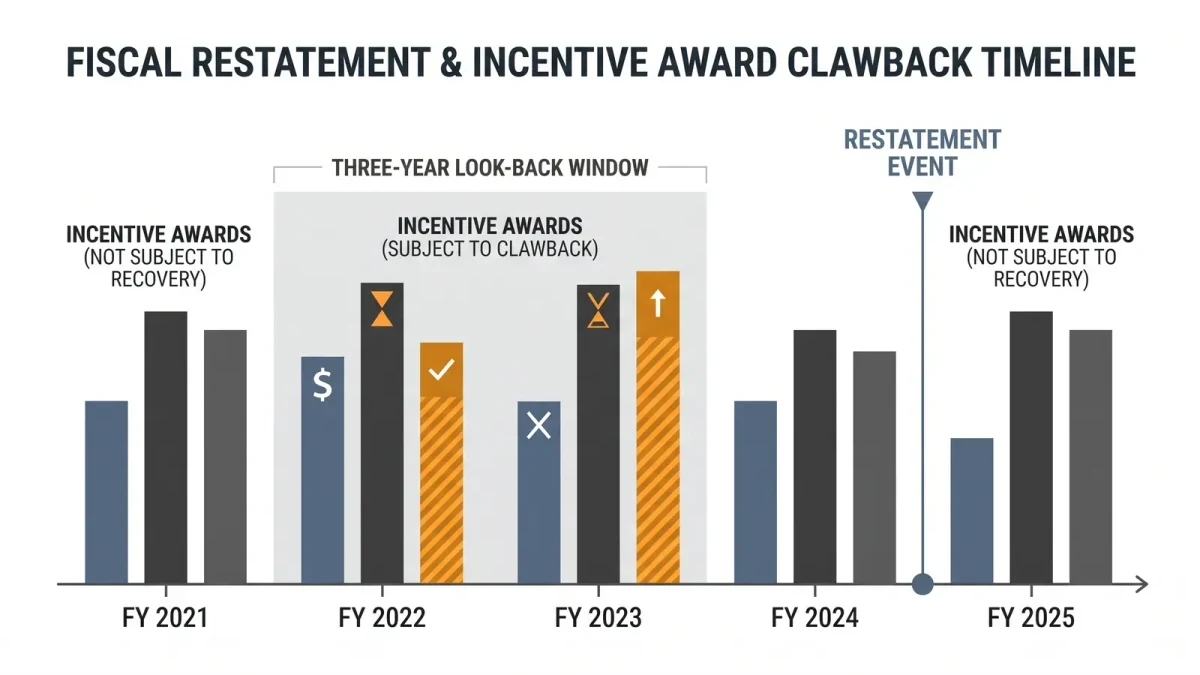
Clawback rules require companies to recover incentive-based executive compensation when it was paid on financial results later restated. The operative regime is Rule 10D-1 under the Securities Exchange Act, adopted October 2022 and effective through exchange listing standards beginning October 2023: a listed company must recover reasonably promptly the excess incentive-based compensation received by current and former executive officers during the three completed fiscal years before a restatement — regardless of fault, misconduct, or when the restatement is filed. The older, narrower Section 304 of Sarbanes-Oxley remains alongside it, applying only where misconduct led to a restatement, and enforced by the SEC rather than the company.
USA Post publishes information about compensation regulation, not legal advice.
What does Rule 10D-1 require exactly?
Recovery of "erroneously awarded" compensation: the excess of incentive-based pay received over what would have been received based on the restated amounts, computed without regard to taxes paid. It applies to Section 16 officers (the CEO, CFO, and other executive officers performing policy functions), to compensation based on financial reporting measures — stock price and TSR included, which the SEC's rule reaches expressly — and covers the three completed fiscal years preceding the restatement requirement date. The no-fault architecture is the rule's defining feature: the company must pursue recovery even where the executive did nothing wrong and the restatement was innocently discovered. Impracticability exemptions are narrow — direct third-party litigation expense exceeding recovery, home-country conflict for foreign private issuers, and tax-qualified plan limits — and an incentive not to use them: recovery decisions exempting an officer require disclosure of the names and amounts.
How does it interact with Sarbanes-Oxley 304?
SOX 304 predates and is narrower: it permits the SEC to seek disgorgement of CEO and CFO incentive pay and stock-sale profits in the twelve months before a restatement, but only "if misconduct" — misconduct — led to the misstatement, and only the agency can enforce it (no private right, as courts consistently hold). The SEC uses 304 in enforcement actions and has litigated its reach to issuers restating for reasons executives did not cause — the Second Circuit's 2015-2020 Jenkins line held misconduct by the executive is not required, an interpretation the commission pressed before its 2023-2025 posture softened. The two regimes stack: a company performs 10D-1 recovery mandatorily, while the SEC separately may pursue 304 disgorgement and penalties in a fraud case — as major accounting-fraud settlements through 2025 demonstrate.
What happened in practice since 2023?
The anticipated wave of restatement-driven recoveries proved modest — restatements are rare and most affect compensation immaterially — but the rule's procedural footprint arrived fully: every listed company filed its clawback policy as an exhibit to the 10-K, the compensation committee's recovery analysis became a disclosure item (a check-box on the 10-K cover page flags restatements with recovery analysis), and proxy statement disclosure describes the policy. The enforcement-adjacent development is litigation over amended cover-page disclosure: securities plaintiffs treat the restatement checkbox as an event marker, and several 2024-2025 decisions tested whether checkbox timing and clawback disclosures were misleading. Delaware fiduciary litigation added a second layer: derivative claims that boards failed to adopt or enforce compliant policies — the In re The Lion Electric-adjacent docket and the SEC's first listed-company enforcement for failing to file a compliant policy (the 2024 actions against issuers that never adopted one) confirmed the rule has teeth beyond recovery math.
What should compensation committees do?
- Adopt the policy as filed — not a bespoke watered version — and map every incentive plan, including cash bonuses with financial metrics and PSUs, to the recovery mechanics.
- Build the calculation spreadsheet before a restatement: for each metric-based award, recompute awards under restated figures automatically, including the harder TSR-based estimates the SEC permits.
- Coordinate disclosure: the restatement checkbox, the 10-K recovery discussion and any officer-level exemption disclosure travel together; sequence them with the audit committee's restatement process.
- Consider going beyond the rule voluntarily — misconduct-based clawbacks covering harassment and fraud convictions — as many large companies do, while keeping the mandatory minimum exactly compliant.
- Contract for it: employment agreements should acknowledge recovery rights and the no-fault standard, closing the collection litigation risk for former officers.
Do clawbacks actually recover money?
Less than headlines imply, more than pre-2023. Historical SOX 304 recoveries were agency-negotiated amounts in enforcement settlements; Rule 10D-1 recoveries are now company-executed, with dozens of companies disclosing recoveries in the hundreds of thousands to millions — occasionally larger in accounting-fraud cases — offset by practical obstacles: former officers' collection suits, foreign-executive enforcement, and the de minimis exemption for small amounts (the rule allows skipping recovery below $25,000 net of tax considerations when pursuing it would be impracticable, a threshold companies apply more often than expected). The rule's larger effect is preventive: metric-based pay is now designed with restatement sensitivity in mind — simpler metrics, cleaner audit trails, and compensation-committee review of which financial measures the company can restate cleanly.