Delisting of foreign companies from U.S. exchanges is governed by two overlapping regimes: the Holding Foreign Companies Accountable Act (HFCAA), which mandates a trading prohibition when the Public Company Accounting Oversight Board cannot inspect an issuer's auditor for two consecutive years, and ordinary exchange delisting rules — listing standards, minimum price, market value — which apply to domestic and foreign issuers alike. The HFCAA, passed in December 2020 and strengthened by the Consolidated Appropriations Act of 2023, is the regime with geopolitical teeth: it drove the 2022 start of delisting proceedings against Chinese state-affiliated issuers and remains the standing constraint on U.S.-listed China-based companies, most of which resolved the confrontation by agreeing to inspected audits.
How does the HFCAA process actually run?
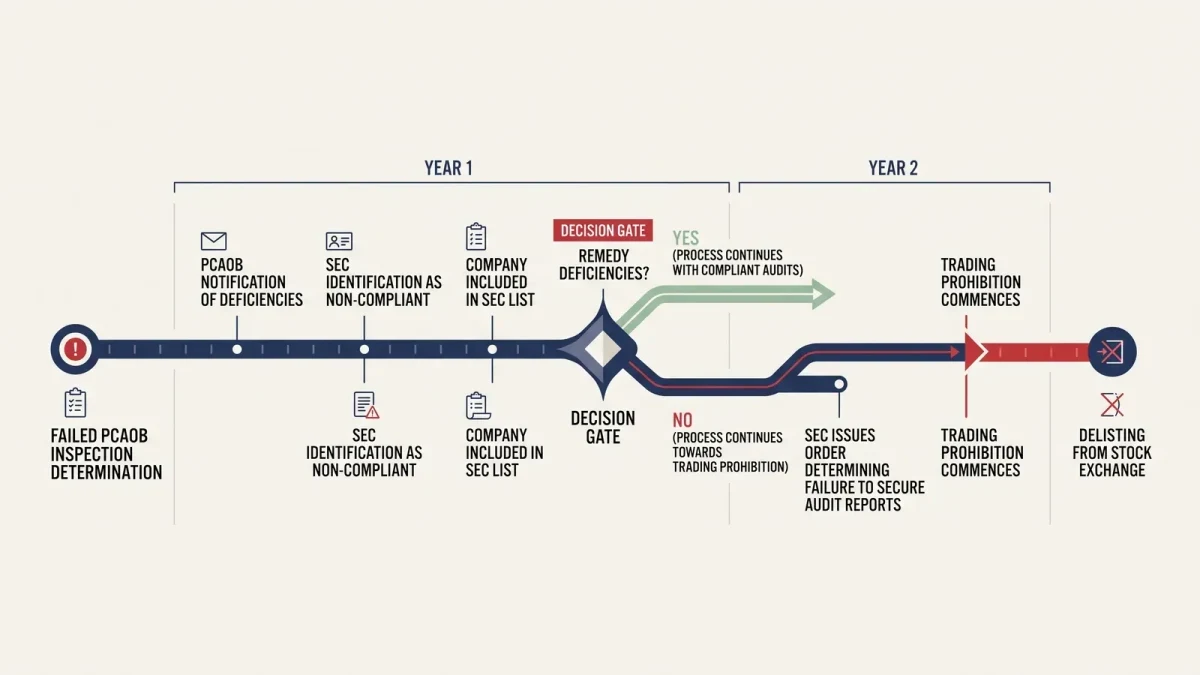
The PCAOB determines annually whether it can inspect auditors in a given jurisdiction; where it cannot, the SEC identifies issuers audited by firms in that jurisdiction and designates them as "commission-identified issuers," published annually with a filing due on Form 20-F or 10-K. Two consecutive years of designation trigger the trading prohibition: the SEC prohibits trading of the issuer's securities in the United States, initially on a provisional basis with withdrawal procedures, then permanently after a securities-exchange delisting process. The 2023 amendments made the determinations annual and irreversible per year — an issuer cannot cure a prior designation. Inspections themselves are the technical predicate: PCAOB access to audit workpapers and personnel, tested in practice during the 2022 Hong Kong inspections of Chinese auditors, which resolved the existential threat for Alibaba, JD.com and peers and led to the withdrawal of the provisional delisting identifications.
What happened to the Chinese issuers the process caught?
A split outcome. The majors stayed: after the August 2021 crisis — when SEC Chair Gary Gensler announced the HFCAA clock would run and Chinese regulators simultaneously banned data transfers — the two governments negotiated an audit-inspection agreement (August 2022), PCAOB inspectors gained access in Hong Kong, and by December 2022 the board declared the barrier removed, withdrawing identifications before any major completed the two-year trigger. The state-owned enterprises did not survive the squeeze: China Mobile, China Telecom and China Unicom were delisted by the NYSE in 2021 under an earlier executive order regime, and in 2022 the SEC's first provisional identifications included several SOEs whose audits never became inspectable. The ADR structure remains available but the compliance price rose: full inspection access, disclosure of VIE structures and government party affiliations, and the risk that U.S.-China relations close the door again.
What are the ordinary delisting paths beside HFCAA?
Exchange-initiated delisting for listing-standard failures — bid price below $1 for 30 consecutive days (with compliance periods and possible reverse splits), equity or market-value deficiencies, and governance failures — followed by Form 25 notification and the SEC's Form 15 deregistration to end reporting. Voluntary delisting is strategic: companies cite compliance costs, low U.S. trading volume relative to home-market listings, or geopolitical exposure; the mechanics require board approval, exchange notification and — under Exchange Act 12(d)(3) if the issuer has 300 or more U.S. resident holders of record — cannot be used simply to escape registration, which is why deregistration attempts by foreign private issuers turn on record-holder counts and often require reducing U.S. holders below thresholds over time.
What happens to shareholders after a delisting?
The securities do not vanish. ADR programs continue over-the-counter if the depositary keeps the facility open — though OTC trading thins and the HFCAA prohibition bans trading altogether, including OTC, for sanctioned issuers. Home-market listings or Hong Kong listings absorb liquidity where they exist — the dual-primary listings of Alibaba (2022) and peers pre-delisting were insurance built for exactly this risk. For investors in a permanent-prohibition issuer, the exit is whatever the depositary's cancellation terms allow: selling into the home market where convertible, or holding a paper with no U.S. market. This is why HFCAA risk appears in institutional portfolio-construction decisions years before any trigger date.
How should issuers and investors monitor the risk?
- Track the PCAOB's annual inspection-access determinations — the root fact everything else follows from.
- Check the SEC's commission-identified issuer lists each spring; a first designation starts the clock.
- For issuers: maintain inspection access contractually with auditors, prepare home-market or dual listing as insurance, and disclose HFCAA status accurately — misstatements there have drawn securities litigation.
- For investors: distinguish trading-prohibition risk (HFCAA) from ordinary delisting risk (standards), and check the depositary agreement's cancellation terms for the tail scenario.
- Watch geopolitics: the regime's force is regulatory, but its triggers are diplomatic, and the 2021-2022 arc shows how fast the channel can narrow.
Is the HFCAA era over?
The crisis phase is, the regime is not. Inspections continue under an arrangement that survived through 2025, but the statute's two-year clock stands ready if access lapses, the annual identifications continue for auditors in inaccessible jurisdictions, and the broader direction — disclosure of VIE structures, government ties, and sanction exposure — keeps foreign-listing risk a standing diligence item. The U.S. market remains open to foreign issuers; the terms of admission now include an auditor the American regulator can inspect, and everyone pricing these securities prices that condition.