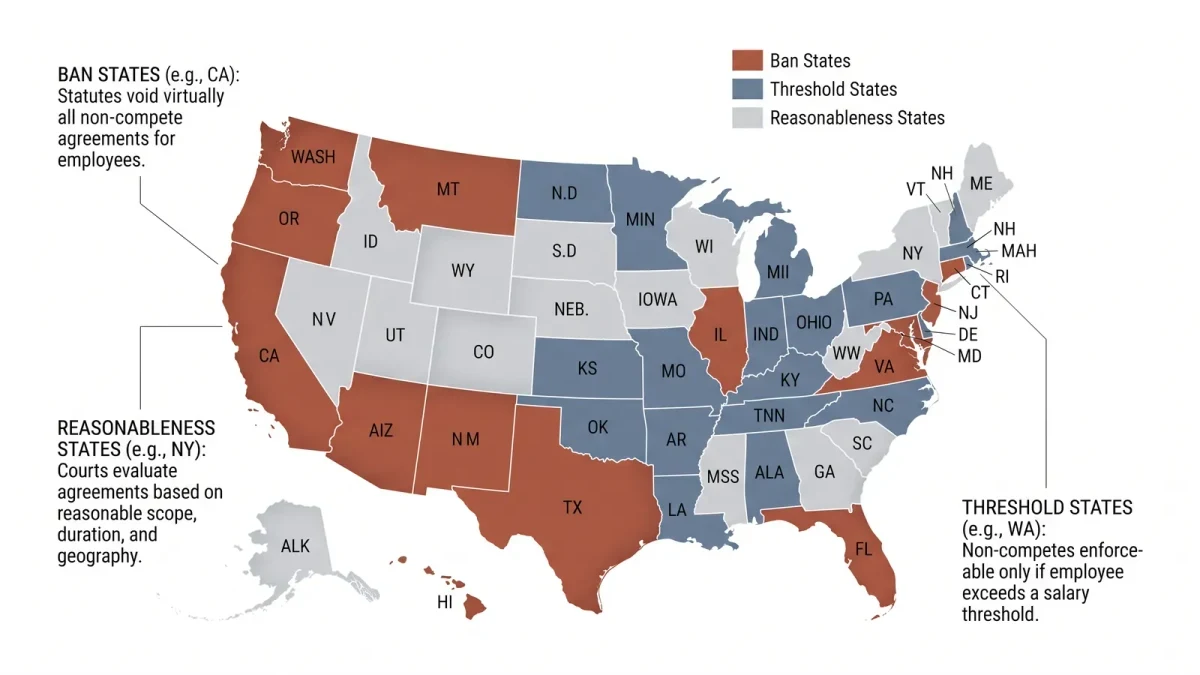
Non-compete agreements — covenants restricting where employees may work after leaving — are governed mostly by state law after the FTC's attempted federal ban was set aside. In April 2024 the Federal Trade Commission issued a rule declaring non-competes an unfair method of competition and banning them nationwide; on August 20, 2024, days before the effective date, the Northern District of Texas in Ryan LLC v. FTC set the rule aside as arbitrary and in excess of the Commission's authority, and the Fifth Circuit's 2025 decision left that outcome in place while confirming courts remain free to scrutinize specific non-competes under the Sherman Act. Employers now operate under a patchwork: several states ban non-competes outright, most enforce reasonable ones, and federal case law treats overbroad restraints as potential antitrust violations.
USA Post publishes information about employment and competition law, not legal advice.
What did the FTC rule attempt, and why did it fail?
The rule, issued April 23, 2024, would have made it unlawful to enter, enforce or attempt to enforce post-employment non-competes with any worker, with a carve-out for existing agreements with senior executives. The commission rested on Section 5 of the FTC Act and a record of roughly 26,000 comments estimating substantial wage suppression. Judge Ada Brown's Ryan decision held the rule arbitrary and capricious — finding the one-size-fits-all approach inadequately justified and the subsantial-record assertions unsupported — and concluded the FTC lacked authority to issue substantive rules regulating competition practices this way. The Fifth Circuit affirmed the set-aside in 2025 on largely the same grounds without reaching the constitutional questions. A nationwide set-aside means the rule is unenforceable everywhere; an appeal to the Supreme Court remained possible but the rule was not in force as of early 2026.
What can employers still enforce?
The familiar toolkit. Non-solicitation covenants (customers and employees), confidentiality and trade-secret agreements under the Defend Trade Secrets Act and state UTSA statutes, and clawback or forfeiture-for-competition provisions in equity awards — though forfeiture-for-competition sits uncomfortably in states like California that void the underlying covenant. Garden-leave and fixed-term employment contracts are alternatives that buy restraint through compensation rather than prohibition. Trade-secret litigation remains the strongest federal backstop: inevitable-disclosure doctrines and DTSA ex parte seizures can reach the same conduct a non-compete targeted, without a non-compete.
Which states ban or limit non-competes?
California, North Dakota, Oklahoma and Minnesota ban post-employment non-competes for most workers; California's Business and Professions Code Section 16600 voids them and Section 16600.5, effective 2024, added employee-friendly remedies including a private right of action with attorneys' fees for forced signatures. Colorado, Washington, Illinois, Oregon, Maryland, New Hampshire, Virginia, Pennsylvania (by common law for low-wage workers) and others impose income thresholds and notice requirements. Washington's 2019-2020 statute caps duration at 18 months for higher earners and presumes anything longer unreasonable. New York City and state proposals have oscillated; as of early 2026 New York enforces reasonableness with heavy judicial trimming. Multi-state employers must draft to the most protective regime the employee works in — choice-of-law clauses selecting a friendly state routinely fail when the employee works in a banning state.
How do courts test reasonableness?
The majority rule, from Mitchell v. Reynolds through modern state doctrine, asks three questions: is the restraint no greater than necessary to protect a legitimate interest (trade secrets, customer relationships, goodwill), does it cover a reasonable territory and time, and does it harm the public. Courts blue-pencil in some states ( Wisconsin, Georgia by statute) and refuse to rewrite in others (Louisiana voids entirely). Sales-employee customer non-competes and physician agreements draw the most litigation. The trend visible in 2024-2025 decisions is stricter scrutiny of rank-and-file restraints: judges increasingly note, as the FTC record argued, that non-competes have migrated from executives to sandwich makers and camp counselors, and skepticism colors the reasonableness balance.
What should employers do now?
- Audit the non-compete inventory by state and role; retire agreements in banning states and for workers without protectable interests.
- Replace blanket non-competes with tailored non-solicitation, confidentiality and trade-secret agreements.
- Consider garden-leave or paid-restraint structures where the jurisdiction honors them.
- Review equity documents: forfeiture-for-competition provisions need state-law mapping as much as covenants do.
- Watch for revived federal action — a future Commission could litigate specific non-competes under Section 5 case-by-case, which Ryan does not forbid — and for the annual wave of state amendments.
Is the underlying pressure gone because the rule died?
No. The FTC's economic case — wage suppression and reduced mobility — is now part of the judicial background, states continue legislating, and plaintiffs' firms increasingly counter-sue to void covenants and collect fees under statutes like California's. The employer that treats Ryan as restoration of the old regime is reading one win into a trend line that runs the other way; enforceability survives, but the drafting margin has narrowed.