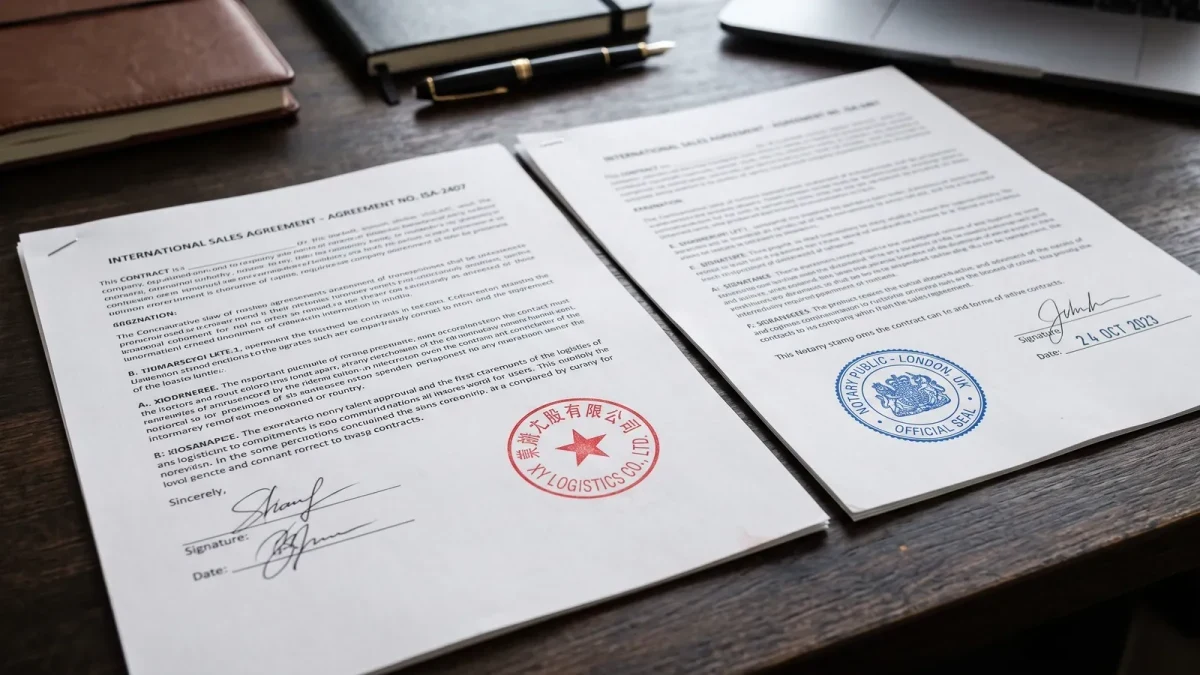
The Convention on Contracts for the International Sale of Goods — the CISG or Vienna Convention — is a uniform treaty law governing contracts for the sale of goods between parties in different member states, which now number over 95 including the United States, China, Germany and Japan; the United Kingdom completed accession with entry into force expected in 2026. The default rule surprises many commercial parties: when both parties are located in member states, the CISG applies automatically, silently displacing domestic contract law like the UCC, unless the contract expressly opts out. Countless U.S.-China and U.S.-Germany sales contracts are governed by the CISG today without either party knowing it.
USA Post publishes information about international sales law, not legal advice. Cross-border contract parties should confirm governing-law language with counsel.
When does the CISG apply?
Article 1 supplies two routes: parties located in different member states (1(1)(a)), or a conflict-of-laws rule pointing to a member state's law (1(1)(b)) — though China, the U.S. and several others declared reservations under Article 95 excluding the (b) route. "Location" for companies is the place of business; where a party has multiple, the one with the closest relationship to the contract controls. The Convention covers sales of goods — not consumer purchases under Article 2(a), not electricity, ships, aircraft, securities or services-dominant contracts under Article 3. Goods bought for personal use are excluded, a frequent trap in e-commerce disputes over whether a buyer was really a consumer.
How does it differ from the UCC?
In texture more than outcome. The formation rules are liberal — no statute of frauds: Article 11 lets contracts be proven without writing, and though Article 96 lets states require writing, most reservations are historical. The battle of the forms resolves differently: under Article 19, a reply adding or altering terms materially is a rejection and counteroffer, and there is no UCC 2-207 knockout rule; instead, contract terms are the offer plus non-material modifications, with standard terms that materially differ dropping out. remedies differ in detail: the CISG's fundamental-breach standard (Article 25) gates avoidance of the contract — a buyer cannot reject for any nonconformity, only those substantially deprive expected benefit; the 30-day reasonable-interest-rate interest rule under Article 78 leaves rates to tribunals; and mitigation is explicit in Articles 77 and 85-88. Perhaps most practically, notice rules are strict: a buyer must examine goods and give notice of nonconformity within a reasonable time or lose remedies entirely (Article 39).
Should parties opt out or opt in deliberately?
Counsel split, but the professional consensus is: choose deliberately. Opting out ("this contract is governed by the laws of the State of New York, excluding the United Nations Convention on Contracts for the International Sale of Goods") restores UCC familiarity. Opting in even where a non-member is involved harmonizes the framework. Staying silent means the CISG applies by default between member states — workable, but litigated surprises cluster where one side assumed the UCC: no written-memorandum requirement, the materiality filter on rejection, and the notice-preclusion rule. Arbitration adds a layer: tribunals apply the CISG as treaty law where it governs, and institutional rules (ICC, CIETAC, SIAC) see it routinely; a clause choosing "New York law" without more does not exclude the CISG, because for an international sale the Convention is part of that law.
What are the recurring CISG disputes?
Four patterns dominate the case law, which the Pace University database tracks across thousands of decisions. First, quality claims lost to late notice — Article 39's reasonable-time bar is the single most successful defense. Second, fundamental breach fights over partial nonconformity in commodity and machinery deals, where tribunals weigh proportionality. Third, standard-terms battles under Article 19(3)'s materiality list — price, payment, quality, quantity, delivery, liability, dispute resolution. Fourth, avoidance and substitute-transaction damages under Articles 74-77, including the famous cover-damages logic parallel to UCC 2-712.
How should a company operationalize CISG awareness?
- Map counterparty locations: member-to-member sales mean the CISG governs by default.
- Decide opt-out/opt-in per counterparty market and write the choice into the governing-law clause expressly.
- Train purchasing and QA on the notice rule: document inspection and send nonconformity notices promptly, with specifics.
- Align Incoterms and CISG: the Convention governs delivery obligations that Incoterms allocate — use them together, not instead of each other.
- For consumer-facing cross-border sales, document B2B character — invoices, resale indicia — since Article 2(a) excludes consumer buys.
Where is the CISG heading?
Toward wider coverage and deeper case-law harmonization. Accessions continue — the UK's accession process advanced through 2025 with entry into force expected in 2026 — and the UNCITRAL digest plus the CISG Advisory Council opinions have narrowed interpretive divergence between tribunals. For trading companies, the direction matters less than the default: the treaty is already the governing law of most of the world's manufacturing trade, and contract drafters who treat it as optional background are drafting against their own assumptions.