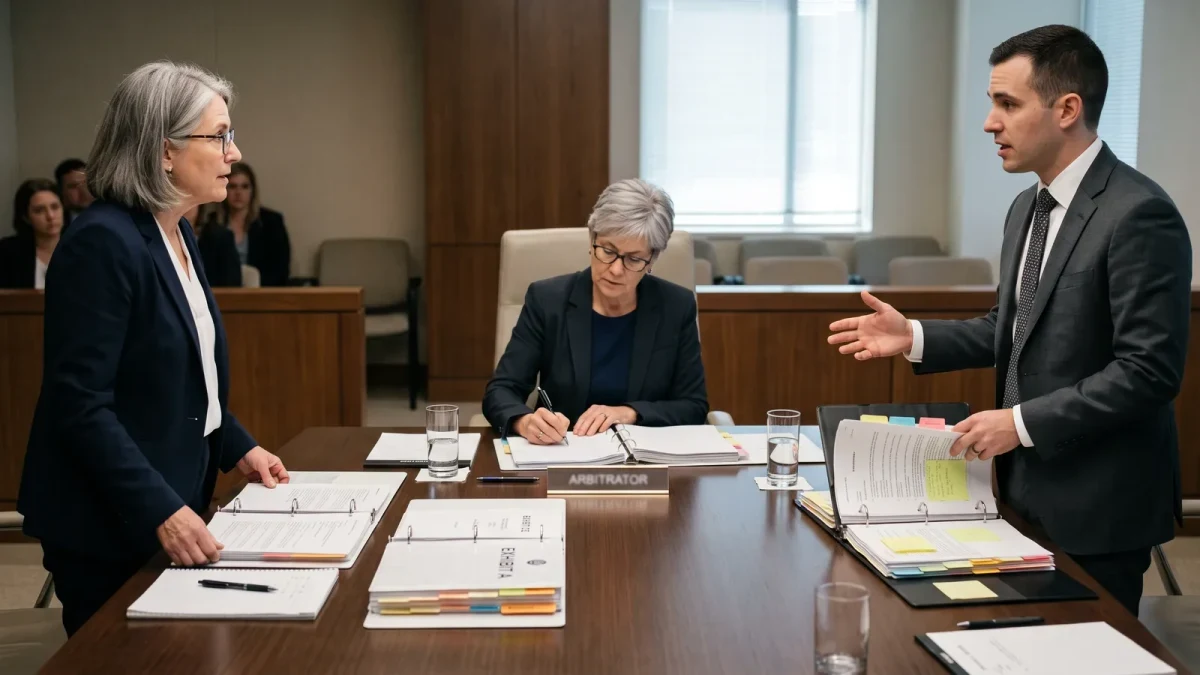
An arbitration clause is a contract provision requiring the parties to resolve disputes through binding arbitration — a private adjudication before one or three arbitrators whose award is enforceable in court with almost no appeal — instead of litigation. Governed by the Federal Arbitration Act (FAA), which makes agreements to arbitrate valid and enforceable like any other contract, the clause's power lies in what it controls: the forum (AAA, JAMS or an industry body), the seat and governing law, the arbitrator selection method, discovery scope, confidentiality, and — the most consequential modern feature — whether claims proceed as class actions at all, since individual-arbitration requirements with class waivers are enforced under AT&T Mobility v. Concepcion (2011).
USA Post publishes information about dispute-resolution law, not legal advice.
What makes arbitration different from litigation?
Five structural differences carry the decision. Finality: the FAA's grounds for vacating an award — corruption, evident partiality, misconduct, or the arbitrator exceeding powers — are narrower than appellate review; a wrong-but-arguable decision stands. Speed and cost: a single-arbitrator commercial case typically resolves in 12-18 months versus multi-year litigation, though multi-arbitrator and discovery-heavy cases erode the savings. Privacy: no public dockets or published opinions — valued in commercial and employment contexts alike. Expertise: parties can select arbitrators with industry or technical backgrounds. Procedure: discovery is limited by the arbitrator's discretion and the clause's terms — a cost saver that becomes a risk in document-heavy disputes. The trade-off is real: arbitrating against a stronger party means giving up the publicity, broad discovery and appellate safety nets of courts.
How should the clause be drafted?
Deliberately on each lever. Institution and rules: name AAA, JAMS or the specific rules and version — institutional administration adds fee schedules and procedure. Seat: the legal place of arbitration determines supervising courts; New York and Delaware seats are common for contract-law predictability, with the clause choosing governing law separately. Number of arbitrators: one for speed, three for stakes above seven figures. Scope: "any dispute arising out of or relating to this agreement" is broad; carve-outs for injunctive relief and IP ownership let parties run to court for emergencies — and the clause should expressly preserve interim-relief access. Escalation: negotiation and mediation tiers before arbitration resolve most commercial disputes cheaply. Fees: default rules allocate arbitrator costs; consumer-facing businesses should note that making claimants bear forum costs can render a clause unenforceable as the Seventh Circuit and California authorities held where costs were prohibitive — pay the arbitrator's fees where the counterparty is an individual.
How do class action waivers work?
By coupling the arbitration agreement with a provision that claims be brought individually. Concepcion held that the FAA preempts state rules striking class waivers — California's rule fell — and subsequent decisions extended the principle: American Express v. Italian Colors (2013) enforced waivers even where individual claims were economically irrational, and Epic Systems v. Lewis (2018) upheld employment class waivers against NLRA challenge, with Lamps Plus (2019) narrowing ambiguous clauses to individual arbitration rather than class arbitration. The practical effect: mass claims disaggregate into individual arbitrations — thousands of small claims become individually uneconomical — which is the clause's value and its controversy. State-law countermeasures persist (California's AB 51 was preempted by Chamber of Commerce v. Bonta (9th Cir. 2023), but PAGA representative actions survived as non-waivable in part per Viking River and 2024's PAGA reform), and the CFPB's attempts to ban arbitration clauses in consumer finance were repealed by Congress in 2017 — leaving the waiver regime standing but politically contested.
When do courts refuse to enforce arbitration clauses?
On contract-formation and unconscionability grounds, rarely on public policy. Formation: no meeting of the minds — silence or ambiguous language construes against arbitration (the Lamps Plus doctrine); click-through terms bind where reasonably presented (Meyer v. Uber, 2d Cir. 2017). Unconscionability: procedural (opacity, adhesion presented without notice) plus substantive (one-sided terms — fee-shifting only against the claimant, shortened limitations, venue in a distant country) can void a clause under state contract law, applied evenhandedly per Doctor's Associates v. Casarotto. Scope: disputes outside the clause's coverage litigate in court, and delegation clauses — which send arbitrability itself to the arbitrator — enlarge scope unless clearly rejected. Non-signatories bind in limited ways: agency, estoppel from suing on the contract, successorship. And federal statutes can carve out: the Ending Forced Arbitration of Sexual Assault and Sexual Harassment Act of 2021 lets claimants void arbitration for those claims at their election — the one recent substantive congressional limit.
How should businesses decide — arbitrate or litigate?
- Weigh dispute types: repeat-volume consumer or employment disputes favor arbitration with class waivers (mass-claim defense); complex two-party commercial disputes favor arbitration for expertise and speed; injunctive-relief-heavy relationships (IP, non-competes) need court carve-outs.
- Draft the clause to the relationship: rules, seat, law, arbitrator count, fee allocation, and escalation tiers chosen deliberately.
- Publish the clause honestly: conspicuous notice matters for enforceability with individuals.
- Revisit inventory annually: clauses in legacy contracts may not reflect current rules versions; stale clauses still bind as written.
- Train the business teams: the clause's value is realized only when invoked early — disputes escalate into litigation strategy the moment notice letters ignore it.
Is arbitration still expanding?
By volume, yes — consumer and employment arbitration filings have grown every year since Concepcion, with institutional caseloads dominated by individual consumer claims that once aggregated as classes. By doctrine, the current Court has trimmed edges — Badgerow (2022) narrowed federal-court jurisdiction over arbitration applications, pushing more supervision into state courts; Morgan (2022) clarified waiver-by-litigation-conduct. The regime's core — enforce the clause as written — remains stable law, which is itself the drafting lesson: the clause businesses write today is the dispute process it will live in tomorrow, chosen in five minutes of drafting or defaulted to by its absence.