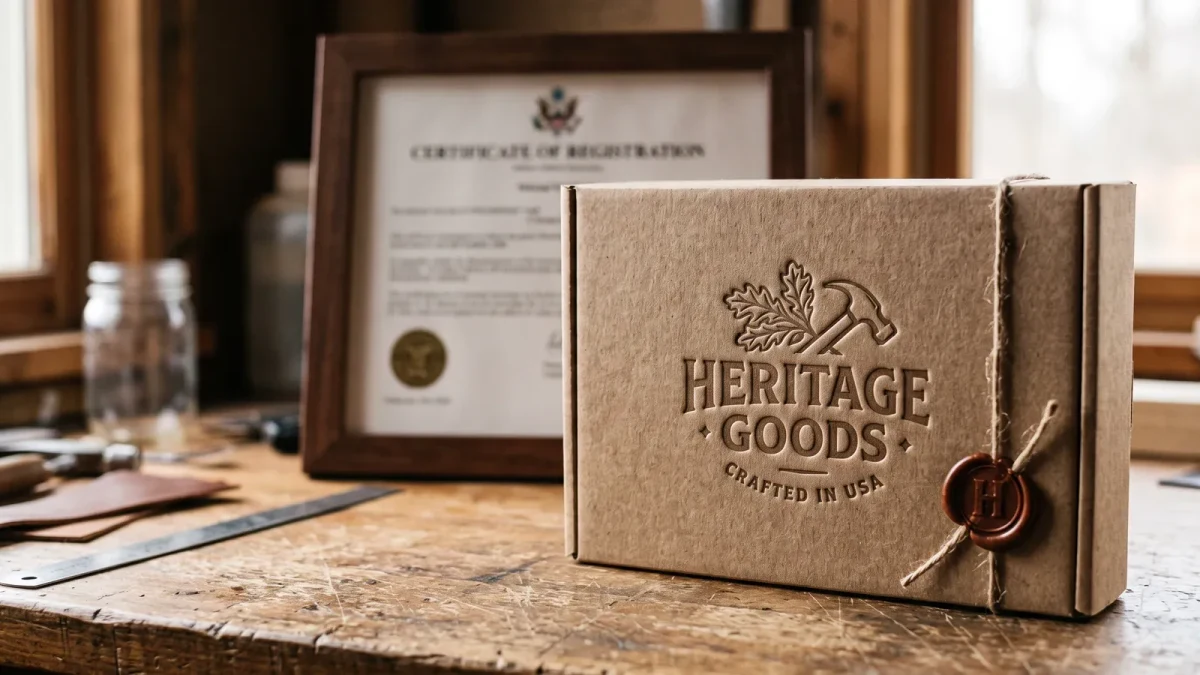
Trademark protection in the United States begins with use: rights arise from actually using a mark in commerce to identify goods or services, and priority goes to the first user. But use alone yields common-law rights limited to the geographic area of sale. The asset-building steps are a clearance search before adopting a mark — because adopting a confusingly similar mark invites infringement liability — and federal registration on the Principal Register at the U.S. Patent and Trademark Office, which confers nationwide priority, a legal presumption of validity, the ability to record with Customs to block infringing imports, and incontestability after five years.
USA Post publishes information about trademark law, not legal advice. Brand decisions deserve a clearance opinion from trademark counsel.
What can function as a trademark — and what cannot?
Words, names, logos, slogans, product configurations, colors, sounds — anything that identifies source. The protection spectrum governs strength: fanciful and arbitrary marks (coined words; everyday words used unrelatedly) are strongest; suggestive marks are protectable; descriptive marks require secondary meaning — proof consumers associate them with a source — before registering; generic terms never qualify. The TTAB's docket and the Supreme Court's decisions in the 2017-2023 line (from Matal v. Tam to Jack Daniel's v. VIP Products, holding that even expressive-parody use can infringe when used as a source identifier) reaffirm that distinctiveness is the threshold question. Functional features — a product shape that works better — are excluded, the doctrine of TrafFix Devices v. Marketing Displays.
How does the clearance process work?
Three layers. Knockout search: direct hits in the USPTO database and a web search, cheap and fast. Full search: a professional search (Thomson CompuMark and competitors) covering federal and state registrations, common-law uses, domain names and business directories, analyzed by counsel for likelihood of confusion — the DuPont and Sleekcraft factors courts use: mark similarity, goods/services relatedness, channels of trade, consumer care, and prior user's strength. Adoption decision: proceed, modify, or license. The economics justify the cost — rebranding a launched business after a cease-and-desist letter means new signage, packaging, domains and customer recognition, plus potential damages; the search that prevents it costs a fraction.
What does federal registration involve?
An application specifying the mark, the goods and services classes (the Nice classification), and a basis: use in commerce (1(a)) or intent-to-use (1(b), which reserves priority while the product comes to market). An examining attorney reviews for distinctiveness, conflicts and procedural issues; publications in the Official Gazette open a 30-day opposition window for third parties; registration follows, with maintenance deadlines that owners must calendar — declarations of use between the fifth and sixth year (with optional incontestability), renewal at every tenth year, and use-based declarations in between. The USPTO's 2019-2022 rules requiring U.S.-licensed attorneys for foreign applicants, and its crackdowns on inaccurate specimen evidence (the 2023-2025 enforcement wave against bulk fraudulent filings), raised filing hygiene; accurate specimens of real use are now scrutinized seriously. Cost: government fees from $250-350 per class under the current fee schedule, plus attorney fees — a modest, single-year outlay for a decade of protection.
How are trademarks enforced?
- Monitor: watch services and platform brand-protection tools (Amazon Brand Registry requires a registration), plus periodic web and USPTO monitoring for confusing filings.
- Enforce early: a measured cease-and-desist letter — most disputes end there — stating rights, the confusion, and a reasonable deadline.
- Escalate proportionately: TTAB opposition or cancellation against conflicting registrations; federal suit under the Lanham Act for infringement, with remedies including injunctions, defendant's profits, damages and, in exceptional cases, fee awards.
- Record registrations with CBP: the e-Recordation program lets Customs seize counterfeit imports at the border — enforcement that costs nothing per shipment.
- Use the mark correctly and consistently: ™ for unregistered, ® only after registration; license with quality control (naked licensing risks abandonment); police genericide — the fate of escalator and aspirin — by correcting generic usage.
What about international protection?
U.S. rights stop at the border. Foreign protection runs through the Madrid Protocol — a single international application designating member countries, each examined under local law — or direct national filings for major markets. Priority timing matters: the six-month Paris Convention priority window lets a U.S. filing anchor foreign applications at the same date. For e-commerce sellers whose infringement risk is borderless, the practical sequence is U.S. registration first, then Madrid designations where sales justify it — China's first-to-file system, despite 2023-2024 reforms penalizing bad-faith filings, still rewards early filing.
Is a name search plus registration the whole job?
No — the trademark asset decays without use and enforcement. Non-use for three consecutive years creates a presumption of abandonment; unpoliced licensing dilutes rights; unmanaged brand usage slides toward generic meaning. The businesses that own strong marks treat them as managed assets: inventoried, renewed on calendar, enforced at the first confusing use, and defended in their scope — neither overreaching into censorship (the Jack Daniel's reminder that weak claims can bring fee liability) nor ignoring the encroachments that eventually swallow a brand.