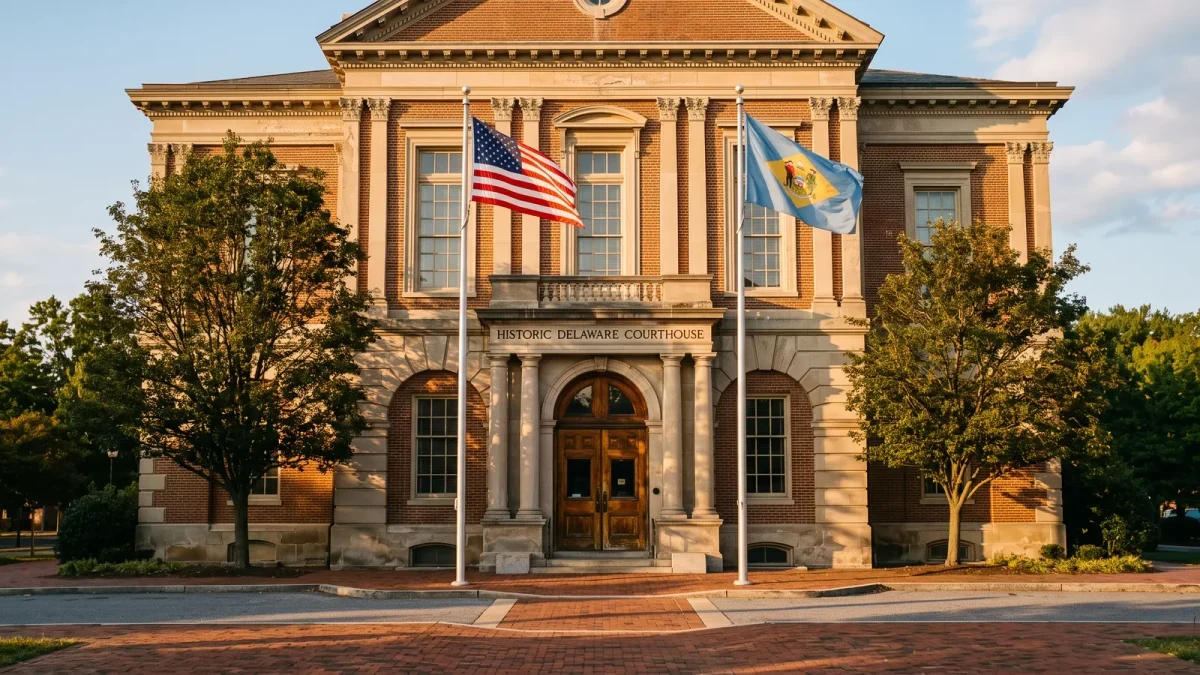
Companies incorporate in Delaware because it offers the most developed corporate-law system in the United States: the Delaware General Corporation Law (DGCL) updated annually with bar-input precision, a Court of Chancery of specialist judges deciding corporate cases without juries and usually within months, and a Supreme Court that has produced the deepest body of corporate precedent in the country. The result is predictability — the most litigated corporate questions in America already have Delaware answers — plus a self-reinforcing network effect: lawyers, investors, deal documents and proxy advisers all default to the same well-worn framework. More than half of the Fortune 500 and the overwhelming majority of venture-backed companies are incorporated there.
USA Post publishes information about corporate law, not legal advice.
What does the Court of Chancery actually offer?
Structure suited to corporate disputes. Chancery judges — currently eight, all experienced corporate lawyers — sit as chancellors in equity without juries, hear cases on paper records and expedited briefs, and can grant remedies federal courts struggle with: injunctions against deal-closing, books-and-records orders under Section 220, custodians and receivers for deadlocked boards. Cases move fast: merger challenges are decided before closing, often within weeks of filing, because the court's calendar and procedure are built for it. Appeals run to the Delaware Supreme Court, itself a specialist corporate tribunal whose decisions bind the doctrine nationwide. For directors and controllers, the practical benefit is that process questions — demand futility, special-committee adequacy, entire fairness — are decided by judges who have seen the fact patterns hundreds of times, in published opinions that let counsel advise outcomes in advance.
What does the DGCL do better than other statutes?
It is updated relentlessly. The Delaware Bar's corporate-law section proposes annual amendments closing gaps revealed by litigation; the legislature enacts them with near-total reliability, making Delaware statutory law the fastest-adapting in the country. Landmark examples: Section 102(b)(7) charter exculpation (2004 officer amendment in 2022), Section 144 cleansing processes (amended 2015 and again refined in 2024 in response to the Match Group line), Section 251(h) two-step mergers without shareholder vote, Section 205 ratification of defective corporate acts, and the 2024 amendments adjusting the MFW safe-harbor mechanics. Other states copy the DGCL with a lag of years; the copies lack the case law that gives each section meaning. That interpretive depth is the product: a Delaware clause's meaning in litigation is knowable ex ante to a degree no other state approaches.
What does it cost, and what are the critiques?
For large companies, franchise tax under the assumed-par-value method is modest relative to the benefits; the minimum tax is $175 plus filing fees, while companies with many authorized shares compute par-value-based liability (capped at $200,000 for assumed-par filers). The critiques are substantive: Delaware's dominance is partly inertia — incorporators choose it because everyone else did, including investors who demand it; the state's revenue dependence on franchise fees raises capture concerns, though empirical work finds its courts independent in practice; and the 2020s brought open challenges — Texas's business-court experiment (2023-2025) recruiting Chancery-adjacent litigation, Nevada's nasdaq-style statutes attracting founder-protective charters, and the national debate over federal incorporation. Delaware responded competitively: 2024-2025 amendments streamlined merger litigation, clarified safe harbors and reaffirmed the state's responsiveness — the recurring pattern of its hundred-year incumbency.
Should a small private company incorporate in Delaware?
It depends on trajectory and cost sensitivity. A local operating business pays registered-agent and foreign-qualification fees in its home state anyway; Delaware adds a second annual filing and agent fee for benefits — Chancery access, DGCL flexibility — a two-owner LLC will rarely use. The calculus flips with investors: venture funds, accelerators and institutional buyers of any size expect Delaware paper, and converting later after appreciation can trigger taxes (entity-level or owner-level depending on structure), so founders planning to raise or sell commonly incorporate in Delaware from formation. The middle path many counsel recommend: home state while bootstrapping, Delaware conversion at the financing's edge, done early enough to be cheap.
How does Delaware law reach companies incorporated elsewhere?
It does not, directly — and that is the point of choosing. The internal-affairs doctrine, settled constitutional law since the twentieth century, applies the law of the state of incorporation to the internal affairs of the corporation: director fiduciary duties, shareholder voting, merger mechanics. A Delaware incorporation therefore buys Delaware law for the questions that matter in governance disputes wherever the company operates, with federal courts sitting in diversity applying the same doctrine. Companies that leave Delaware — the occasional well-publicized reincorporation to Texas or Nevada — are pricing ideology, tax or fee savings against the loss of an interpretive body of law none of those states can yet replicate.
Is Delaware's dominance durable?
Every decade produces a challenger, and every decade the same three assets reassert: Chancery's docket speed, the DGCL's update cycle, and the accumulated precedent that makes Delaware outcomes the most forecastable. The 2020s competition — Texas business courts, Nevada charters, federal-incorporation proposals — is real and may peel segments of the market, particularly founder-maximalist charters. But network effects in law are slow to unwind, and for companies whose value depends on investors trusting the rules that govern them, the safest prediction remains the historical one: the crowd stays where the cases are answered.