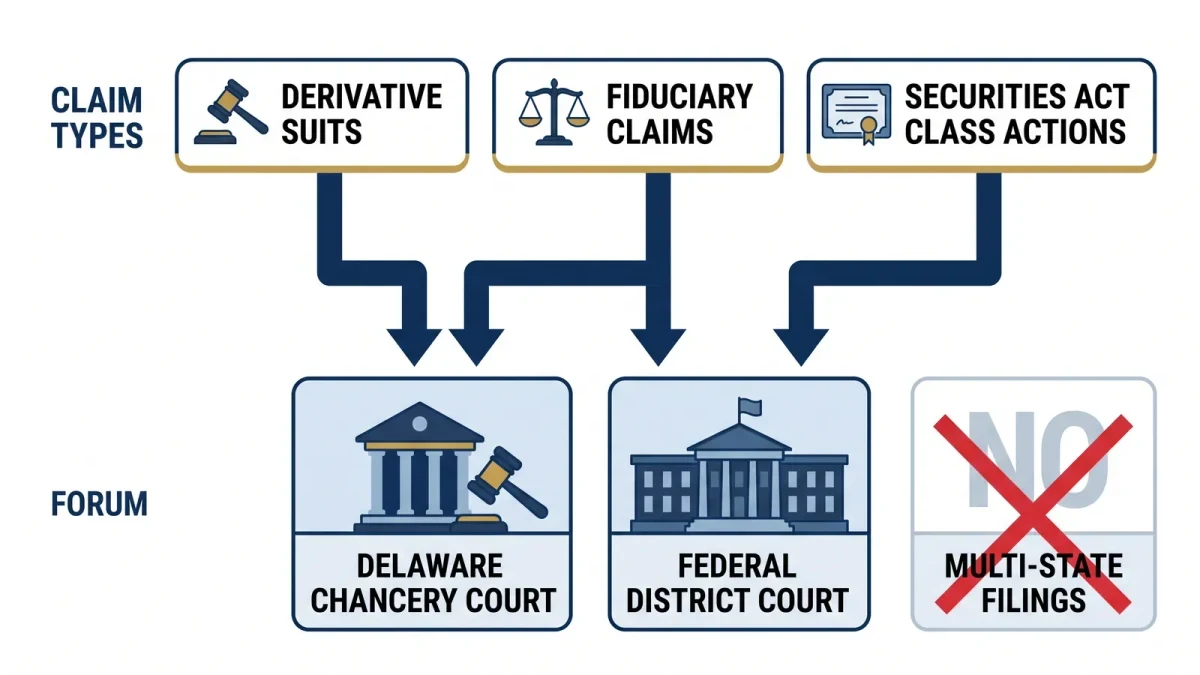
A forum-selection bylaw or charter provision requires lawsuits over a corporation's internal affairs — fiduciary claims, derivative suits, books-and-records demands — to be brought in a specified forum, most often the Delaware Court of Chancery, or, in the federal variant, exclusively in federal court for Securities Act claims. Delaware's Supreme Court upheld their facial validity in Boilermakers Local 154 Retirement Fund v. Chevron Corp. (2013), and the U.S. Supreme Court in Sciabacucchi v. Salzberg (2020) — better known as the Delaware federal-forum case — held that such provisions can channel federal Securities Act claims into federal district courts. The provisions' purpose is to solve multi-forum duplication: the same deal challenge filed in several states producing inconsistent rulings and coercive settlements.
USA Post publishes information about litigation strategy, not legal advice.
Why do boards adopt them?
To manage the forum-shopping wave that followed every significant merger. Before the provisions spread, plaintiffs' firms filed the same case in multiple states, racing to first-filed advantage; defendants faced parallel discovery, inconsistent injunctions, and settlement pressure from whichever court happened to be fastest. Delaware-forum bylaws consolidated the cases where the law is most developed and the judges most expert — reducing cost and, the empirical work finds, not reducing the claims' merits-based outcomes. Federal-forum provisions answered a different problem: Securities Act class actions piling into state courts after the Supreme Court's 2018 Cyan decision held that state courts retain concurrent jurisdiction over '33 Act claims with no removability, resurrecting a plaintiffs'-favorable state-court forum that the 1998 SLUSA had been thought to close. The federal-forum bylaw restored defendants to federal court — and largely ended the state-court Securities Act experiment: filings data through 2025 show the state-court share collapsed among adopting companies.
What did the Sciabacucchi litigation actually decide?
That a Delaware corporation's charter or bylaw may require Securities Act claims — federal claims — to be litigated in federal court. The Delaware Supreme Court reasoned that the constitutional provisions on chartering permit a corporation to define the forum for suits about its stock; the U.S. Supreme Court declined review in 2021 (the certiorari petition in Salta-line cases was denied), leaving the device standing. Its scope matters: it reaches the internal-affairs-adjacent subject of the corporation's own securities issuance; it does not reach third-party claims unrelated to the corporate relationship. And enforcement runs through dismissal: a plaintiff suing in state court in violation of the provision faces a motion to dismiss on forum non conveniens grounds, which the Delaware Court of Chancery supports through anti-suit injunctions in appropriate cases.
What are the drafting choices and limits?
Four open questions resolved by market practice. Scope: most provisions cover derivative suits, fiduciary-duty claims, Section 220 books-and-records, and internal-affairs claims; overbroad versions sweeping in contract or tort claims risk invalidity. Form: charter provisions are strongest (adopted with stockholder approval), bylaws board-amendable ones more flexible — Delaware courts apply an enunciated "fairness" review to unilaterally adopted litigation-affecting bylaws under Kandalaris v. Salt River principles, and Salta v. All Market (Del. 2024) reaffirmed that facial validity extends only so far — an exclusively arbitral forum for federal securities claims remains impermissible while the SEC maintains its policy against such waivers. Notice: the provision binds plaintiffs deemed on notice through disclosure — adopted after the Boilermakers pattern of stockholder-approved or promptly disclosed board action. Foreign incorporation: non-Delaware companies increasingly adopt Delaware-forum or home-forum provisions; the internal-affairs doctrine gives the state of incorporation's law (including its forum rules) governing force.
How have courts treated enforcement in practice?
Even-handedly with an escape valve. Delaware Chancery enforces its forum bylaws consistently, granting anti-suit relief against violative filings in other states. The federal-forum provisions are enforced by federal courts dismissing duplicative state filings — but the 2023-2025 era added nuance: the Delaware Court of Chancery's Wilmington Savings Fund v. Brait-line and the Superior Court's caselaw on exclusive Delaware forums for non-Delaware companies confirm cross-border respect, while several federal district courts, applying ordinary forum-transfer analysis, have occasionally declined dismissal where the federal-forum bylaw operated as a waiver of the plaintiff's chosen venue rights in borderline postures. The safe synthesis: courts enforce clear provisions covering clearly internal-affairs or securities-issuance claims, and construe ambiguities against the drafter.
What should boards consider adopting?
- A Delaware-forum clause for internal-affairs claims — now near-universal practice among Delaware companies.
- A federal-forum provision for Securities Act claims — widely adopted since 2020 and functioning as intended.
- Adopt via charter amendment with stockholder approval where practical; board-adopted bylaws with prompt disclosure otherwise.
- Draft scope tightly to covered claim types; avoid sweeping third-party claims.
- Revisit after litigation: provisions are cheap to adopt and expensive to litigate if drafted beyond what courts will enforce.
Is there a counter-argument worth weighing?
Yes: forum selection reduces plaintiffs' structural advantages — which some argue reduces accountability, not just abuse. The response in the case law is that Chancery and federal courts decide these claims fully on the merits; the empirical record through 2025 shows adoption shifted venue without suppressing viable claims. Boards weigh the governance optics: proxy advisers raised objections in early years but the provisions' ubiquity and neutral effects ended the controversy. What remains true either way: the choice of forum is now a charter-level decision, made deliberately or by default.