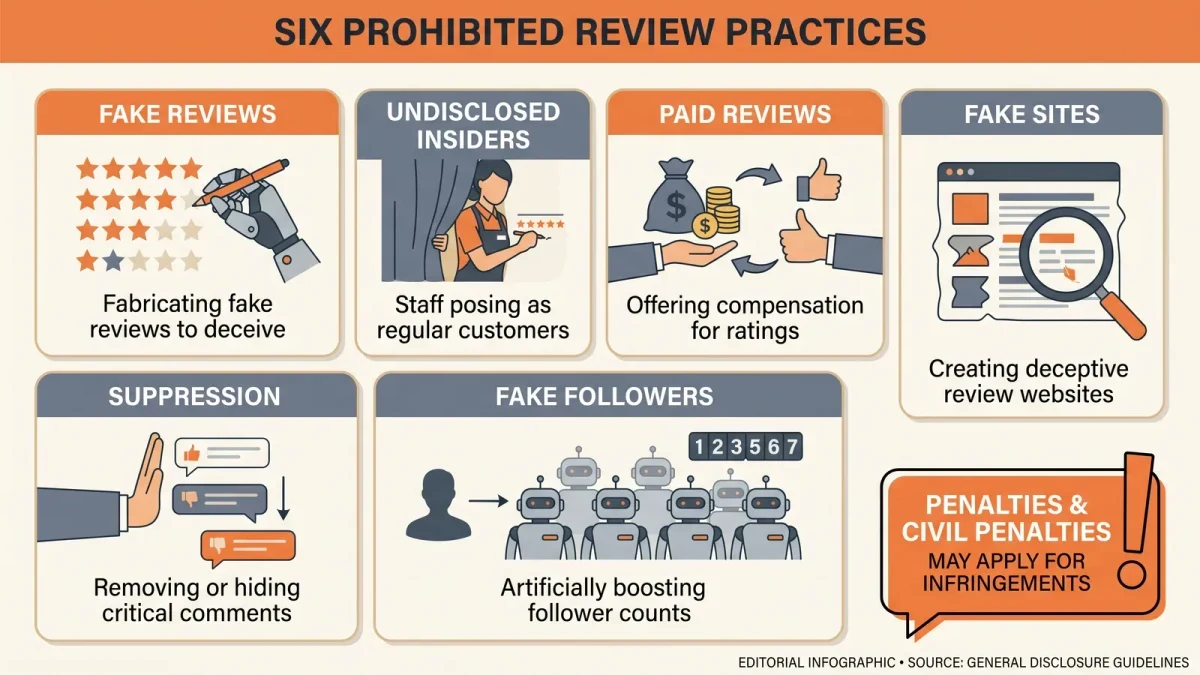
The Federal Trade Commission's Rule on the Use of Consumer Reviews and Testimonials, effective October 21, 2024, makes it a deceptive practice — enforceable with civil penalties — to publish fake reviews, write reviews by insiders without disclosure, buy positive or negative reviews, suppress reviews, and misrepresent review websites as independent. It complements the Consumer Review Fairness Act of 2016, which voids contract terms banning honest negative reviews, and Section 5's general deception authority under which the FTC had pursued review manipulation case-by-case for a decade. The rule's practical novelty is deterrence economics: violations now carry civil penalties per instance rather than merely injunctions, and the first enforcement sweeps under the rule arrived in 2025.
USA Post publishes information about marketing regulation, not legal advice.
What exactly does the 2024 rule prohibit?
Six categories. Fake or false-fact reviews: reviews by people who did not use the product or that misrepresent material facts, including AI-generated reviews presented as real customers'. Insider reviews: reviews by employees or their relatives without clear disclosure of the relationship, and reviews solicited from employees' family. Review suppression: using threats or litigation threats to remove or prevent negative reviews, and misrepresenting that reviews are from all customers when negatives are filtered. Ownership misrepresentation: passing off a controlled review site as independent. Buying reviews: paying or incentivizing positive reviews (or negative ones about competitors), with a narrow exception for up to two solicitations of honest reviews — the "no strings" safe harbor that lets companies ask for reviews but not condition incentives on sentiment. And fake social-media indicators: purchasing followers or engagement metrics that misrepresent influence.
How does this interact with the Consumer Review Fairness Act?
The 2016 statute attacked the contractual side: form contracts that forbid honest negative reviews, claim IP ownership of reviews, or impose penalties for criticism are void as unfair under the FTC Act, and states may enforce alongside. The 2024 rule attacks the supply side — the fake and incentivized positive reviews that game platforms. Together they close the loop: a business cannot silence real critics (CRFA) and cannot drown them with fake praise (the rule). The rule also touches what the CRFA explicitly did not: social-media indicators and influencer disclosures, which had lived under the Endorsement Guides' 16 CFR Part 255 framework — updated in 2023 — whose case-by-case posture is now backed by penalty authority for the specific review practices the rule names.
What did the first enforcement actions establish?
The FTC's 2025 sweeps targeted repeat offenders across e-commerce and hospitality: companies whose internal documents showed deliberate review-generation programs, agencies selling fake-review services, and platforms whose suppression practices met the rule's definitions. The settlements combined modest civil penalties with compliance-monitoring obligations — signaling that the numbers grow with scale and repetition, since each fake review is a separate violation. Alongside the rule actions, state attorneys general began using their UDAP parens patriae authority for review fraud, and platforms' own suits against review brokers (Amazon's long-running litigation program) continued feeding evidence to regulators. The AI dimension drew specific attention: the FTC's staff guidance treats undisclosed AI-generated reviews as per-se fake, and the rule's definition covers them expressly.
What should a compliance program cover?
- Never publish, commission or accept reviews from people who did not genuinely use the product; disclose AI assistance anywhere in the review pipeline.
- Disclose employee and family relationships in any review, and don't run employee-review campaigns without explicit labeling.
- Structure incentives inside the two-honest-review safe harbor: ask for honest feedback, never condition rewards on positivity.
- Scrub contract templates of CRFA violations: no review bans, no non-disparagement clauses, no IP grabs over customer reviews.
- Monitor third parties: agencies and franchisees generating reviews on your behalf create your liability — audit them as you would advertising claims.
- Preserve negative reviews absent genuine policy violations (spam, obscenity); document the policy and apply it evenly.
What are the platforms' obligations?
The rule regulates businesses and platforms that knowingly distribute fake reviews for consideration; general-purpose platforms have safe-harbor-adjacent posture where they operate neutral moderation. The EU's Digital Services Act pressures large platforms on review authenticity from the other direction, and the major platforms' own policies — verified-purchase badges, review-algorithm detection — are the de facto first line. For a business, the platform's takedown of a fake-review burst is not a defense; the FTC's theory reaches the beneficiary who procured it.
Is the rule durable?
Better positioned than most recent FTC rulemaking. It passed through notice-and-comment with bipartisan support, its substance codifies a decade of case-by-case positions rather than novel theory (the defect that killed the non-compete rule), and its subject — review integrity — has no constituency defending fraud. Companies should treat the rule's line as the floor for marketing-compliance training: honest solicitation, disclosed relationships, no suppression — the practices that survive every platform's and regulator's scrutiny are the same ones customers actually believe.