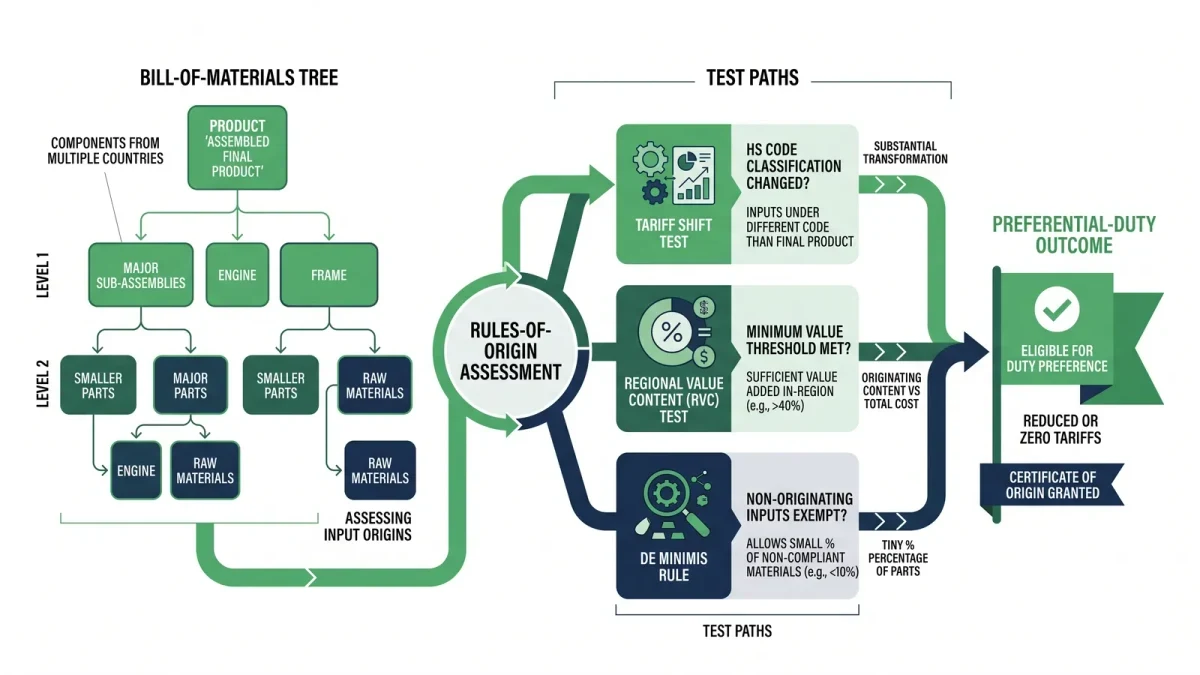
Rules of origin are the tests that determine whether a product qualifies as originating in a free-trade-agreement partner and therefore enters at preferential — often zero — duty. The United States maintains FTAs with 20 countries, including Canada and Mexico under the USMCA, Korea, Australia and Israel; each agreement imposes its own origin rules, generally satisfied in one of three ways: a change in tariff classification (tariff shift), a minimum regional value content (RVC), or substantial transformation where the agreement says so. Claiming preference without satisfying the rule is an underpayment of duty, recoverable with penalties from the importer for up to five years.
USA Post publishes information about trade compliance, not legal advice. Origin determinations should be validated with customs counsel and agreement-specific texts.
Why does every agreement have different rules?
Because origin is negotiated product by product. Each FTA's annex assigns every Harmonized System heading a rule — some require a simple tariff shift (any non-originating inputs must change heading), others add RVC percentages calculated under transaction-value or net-cost methods, and sensitive sectors (textiles, autos, agriculture) carry the heaviest requirements. The USMCA, which replaced NAFTA in July 2020, illustrates the tightening trend: vehicles require 75 percent RVC (up from NAFTA's 62.5) plus steel and aluminum purchasing requirements and, since 2023, a labor-value-content rule tied to wage rates — administered with the first labor-petition cases producing facility-specific enforcement. The lesson for supply chains: identical products qualify under one agreement and fail under another, and qualification is assessed per HS code, not per product family.
How does an importer actually claim preference?
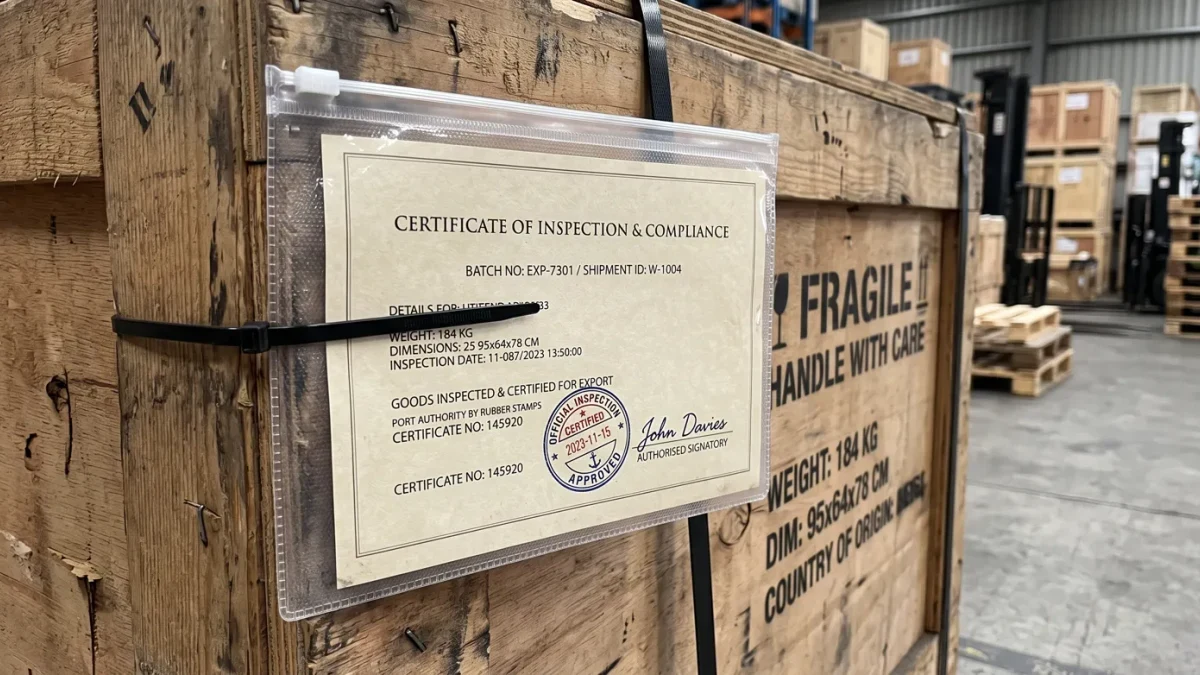
At entry, the importer claims the FTA program code and must possess a certification of origin — under USMCA, a nine-field certification completed by the exporter, producer or importer himself; no government form is required but the data elements are mandatory. Under other agreements, certificates like the Korean-language CO or the importer's knowledge standard (used under some agreements) substitute. The importer of record relies on the certificate but owns the claim: if CBP verifies and the product fails, the importer pays the duty differential and potentially penalties, whatever the certificate said. Verification requests demand production of bills of materials, cost sheets and production records within 30 days; claims are audited, and FTA claims are a standing focus of CBP's focused-assessment program — preferential claims are treated as revenue loss when unsupported.
What is de minimis and how does it help qualification?
Nearly every agreement includes a de minimis clause allowing a small share of non-originating content — commonly 7 to 10 percent of the value, 7 percent under USMCA for most goods — without failing the tariff-shift rule, up to a cap of the finished good's value. De minimis rescues products whose minor inputs fail the shift; textile and apparel de minimis is narrower (USMCA: 10 percent by weight for certain fibers). Reading the de minimis rule alongside the product-specific rule is where qualification analysis usually turns in practice.
How do cumulation and duty drawback interact?
Cumulation lets inputs from specified third countries count as originating — USMCA cumulation covers inputs from countries with FTAs with all three parties, available on request. Duty drawback — the refund of duties paid on imported inputs later exported — is restricted under USMCA (no drawback on conditions claims for goods entering the U.S. from Canada or Mexico), a NAFTA carryover that surprises claimants. Accrual, fungible goods management (the FIFO or LIFO inventory methods permitted for commingled originating and non-originating materials) and indirect-material treatment round out the technical toolkit; each is agreement-specific and must be documented in the origin calculation file.
How should companies manage FTA compliance?
- Build product-level BOM-to-origin calculations for every claimed HS code, refreshed when inputs, suppliers or costs change.
- Collect supplier or producer certifications for each input whose origin feeds the calculation — blanket certifications without data are a verification failure waiting.
- Retain the certification and supporting calculations for five years from importation, the CBP recordkeeping period.
- Respond to CBP verification requests inside the 30-day window or face claim denial across the portfolio.
- Re-qualify when agreements change: USMCA review cycles and 2025-2026 tariff renegotiations shift both preference value and origin math.
Is preferential origin the same as country-of-origin marking?
No — a classic confusion. Marking origin ("Made in Vietnam") follows the substantial-transformation rules for marking under 19 CFR Part 102 or 134 and answers where the good comes from for labeling and for measures like Section 301. Preferential origin answers whether the good qualifies under a specific agreement's rules, which may be stricter or differently structured. A product can be marked as Chinese for 301 purposes and still qualify as Mexican under USMCA analysis — or the reverse. Keeping the two analyses in separate files prevents the most common compliance error in preference programs.