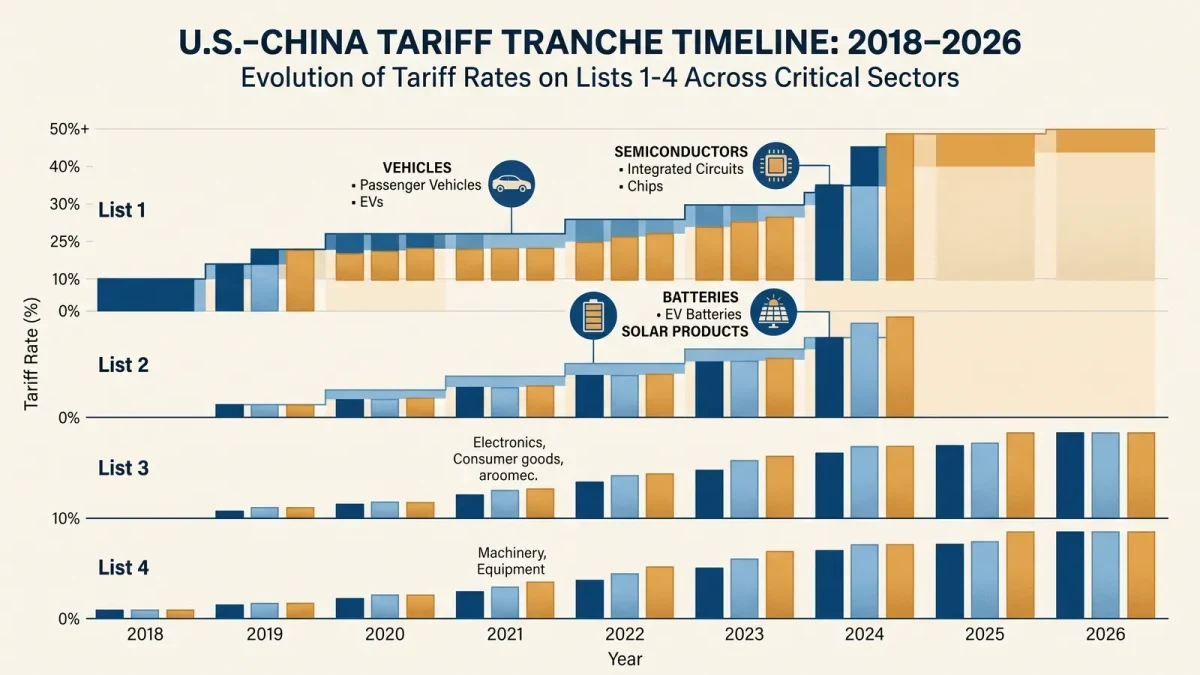
Section 301 of the Trade Act of 1974 is the statute under which the U.S. Trade Representative investigates foreign trade practices it deems unreasonable or discriminatory and retaliates — most prominently with the tariff actions on Chinese goods that began in 2018. As of early 2026, the China Section 301 tariffs cover hundreds of billions of dollars of imports across four tranches, with rates increased by the statutory four-year review that USTR completed in 2024 (raising selected duties on electric vehicles, batteries, solar cells and steel among others, effective in stages through 2025), plus a separate Section 301 investigation into Chinese shipbuilding and maritime practices whose remedies were in progress in 2025.
USA Post publishes information about trade regulation, not legal advice. Importers should verify current rates and exclusions with customs counsel and the Harmonized Tariff Schedule.
How does a Section 301 investigation work procedurally?
The process runs through notices in the Federal Register. USTR self-initiates or accepts a petition, requests public comment, frequently holds hearings, and issues a determination that the foreign practice is actionable. Remedies can include tariffs, import restrictions, or negotiation of agreements. For the China investigation launched in August 2017 under a memorandum from the first Trump administration, USTR found forced technology transfer and intellectual-property practices actionable in March 2018; the first tariff list took effect in July 2018. Each tranche — Lists 1 through 4 — followed the same pattern: proposed list, comment period, exclusions process, and staged effective dates. Any party in the chain — importer of record, downstream purchasers, and in some challenges, U.S. producers — has had standing fights before the Court of International Trade over the tariff's validity, all of which the government won through 2025.
Which goods carry Section 301 duties, and at what rates?
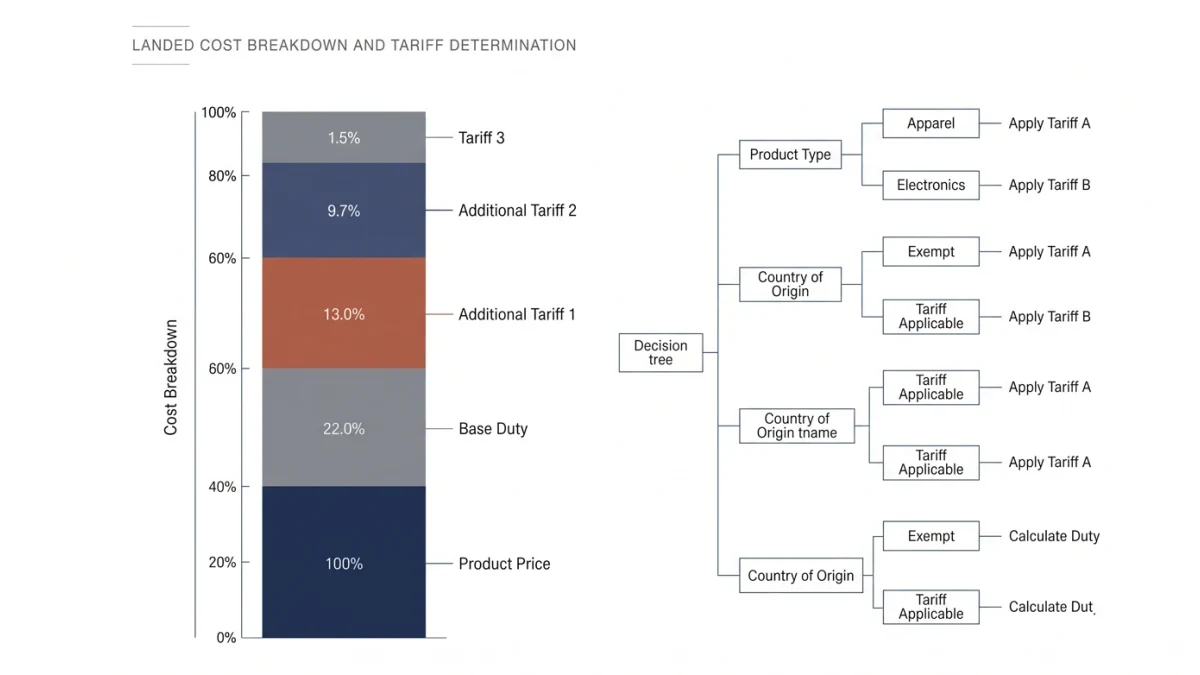
Lists 1 through 3 (roughly $250 billion of trade when imposed) originally carried 25 percent duties; List 4A carried 7.5 percent after a reduction agreement. The 2024 four-year review kept the structure but raised rates in targeted sectors: 100 percent on Chinese electric vehicles, 50 percent on solar cells and semiconductors in stages, 25 percent on lithium-ion non-EV batteries effective 2026 per the review schedule, and higher steel and aluminum rates. These are additive — they stack on regular MFN duty and, in 2025's tariff environment, on new reciprocal-tariff measures imposed under different authorities. The practical rate on any entry is the sum of all applicable programs keyed to the HTS line and country of origin.
How do exclusions and reinstatements work?
USTR has run successive exclusion processes: importers or U.S. producers request that a specific product be excluded, usually arguing the product is available only from China or that the duty causes disproportionate harm. The 2024 review reinstated a set of pandemic-era exclusions through May 2025 and created a new mechanism for temporarily excluding machinery used in domestic manufacturing — with a 381-product temporary list running through 2025 into proposed extensions. Exclusions are product-and-HTS-specific, apply regardless of requester in most China-tranche processes, and require the importer to claim them at entry using the designated HTS provision. Missing an applicable exclusion at entry means overpaying, recoverable only through post-summary correction or protest within 180 days of liquidation.
What compliance obligations do importers face specifically because of 301?
- Classify correctly under the HTS and confirm whether the line appears on any active Section 301 list, including the review-based increases.
- Determine country of origin by substantial transformation, not merely shipping route — transshipment through third countries to evade 301 duties triggers evasion enforcement under EAPA with retroactive liability.
- Claim all applicable exclusions at entry, and monitor Federal Register notices for reinstatements and expirations.
- For goods with China origin entering under other programs, model the stack — MFN plus 301 plus any reciprocal or sectoral tariffs — before pricing.
- Keep records five years from entry (19 U.S.C. 1508-1509) and reconcile entries quarterly; duty-rate errors on 301 lines compound faster than ordinary duty errors.
Can Section 301 duties be challenged or refunded?
The courts have largely closed the broad challenges: the Court of International Trade and the Federal Circuit upheld the List 3 and List 4A tariffs against claims that USTR exceeded authority by acting beyond the findings in its report, with the Federal Circuit's 2025 rulings leaving the framework intact, and the Supreme Court declined to disturb the architecture. Narrow refund paths remain: successful protests where the government misapplied a list or exclusion to an HTS line, and exclusion claims made late but before liquidation. The larger lever is prospective — participating in comment periods for new actions and in the next four-year review cycle, where USTR is statutorily required to consider whether the duties serve the U.S. economic interest and to consider removal requests from beneficiaries of the tariffs.
What should companies expect from 301 in 2026?
Continued use. The four-year review confirmed the mechanism's political durability across administrations; the maritime investigation added fees on Chinese-built vessel operators proposed in 2025; and new petitions in sectors from legacy chips to critical minerals keep the pipeline active. Importers that treat Section 301 as a standing feature of sourcing — with origin engineering, exclusion tracking, and duty-stacking models in their compliance stack — will keep reacting to Federal Register notices rather than to surprise broker invoices.